

Bonus Episode: AuDHD, Friends and Conferences
Failed to add items
Add to basket failed.
Add to wishlist failed.
Remove from wishlist failed.
Adding to library failed
Follow podcast failed
Unfollow podcast failed

Bonus Episode: AuDHD, Friends and Conferences
-
Narrated by:
-
By:
Content warning: brief mentions of trauma, PTSD, dissociative identity disorder, chronic illness and healthcare self-advocacy, and online hatred directed at trans people. Nothing graphic. Look after yourself!
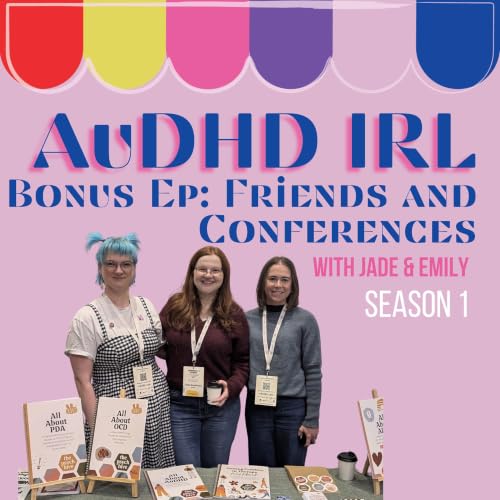
Summary:This one's a bit different. Bri grabbed Emily and Jade, her Psych Hive co-directors and real-life mates, for two quick check-ins recorded live from NATCA (the Neurodivergence Affirming Therapists Conference Australia) in Melbourne. Part one is end of day one, part two is the exhausted-but-glowing wrap after day two, where Jade and Bri also gave their own talk on self-care.
Along the way: spirit animal introductions (Jade's a lemur, Emily's a cheetah, Bri's a labrador who eats shoes, don't ask), a mid-conference "missing person" scare, and a genuinely lovely rundown of what stuck with them from two days of neuroaffirming research and practice.
Takeaways:
Day one, the panel on neurodivergence and medical co-occurrences hit hard: capacity is finite, and the people with the most medical complexity carry the heaviest self-advocacy load. Systems like NDIS and Medicare help some, but the burden of proving your needs still falls on the most disabled.
A talk on trans marginalisation and online hatred, and one on intergenerational trauma from undiagnosed neurodivergence, both circled the same idea: othering breaks connection, and disconnection is where distress grows.
Research on masking and mental health found the harm isn't masking itself, it's what masking does to your sense of self: feeling "less than" and losing a clear identity. The quote that stuck: "I am wrong."
Day two opened with Nick Walker's keynote touched on human flourishing and a genuinely useful reframe: instead of pathology paradigm versus neurodiversity paradigm, think pathology paradigm versus neuronormative paradigm. Some forms of neurodivergence (like PTSD) can genuinely benefit from treatment when the person wants that. Others (like autism) are actively harmed by attempts to cure them. ADHD medication got reframed as an accommodation rather than a cure, since the traits come straight back off it.
A talk on echolalia reframed it as authentic communication rather than "just stimming", it can carry a feeling, a need, a want, or be a bid for connection. There's even a version where people echo movements or emotions, not just words.
The through-line for both of them: connection, not categorisation, is what actually helps people flourish.
They close with a quick word on Psych Hive resources (the OCD guide, the PDA parent guide, the AuDHD books for adults and for parents, free webinars and downloads) and two prize draws running through the AuDHD IRL and Psych Hive email lists. Jade and Emily will be back to talk about building a neuroaffirming practice and being allies.
You can find Jade and Emily on instagram at @thepsychhive and their resources through the website www.thepsychhive.com.