

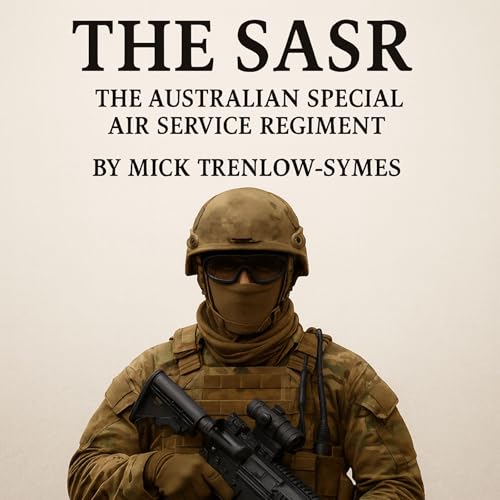
The SASR
The Australian Special Air Services Regiment
Failed to add items
Add to basket failed.
Add to wishlist failed.
Remove from wishlist failed.
Adding to library failed
Follow podcast failed
Unfollow podcast failed
3 Months Free + £10 Audible voucher

The SASR
Buy Now for £9.98
-
Narrated by:
-
John B Leen
From its earliest days as an uncertain experiment in the 1950s, the Special Air Service Regiment (SASR) has grown into one of the most respected – and sometimes most controversial – military formations in the world. Headquartered at Campbell Barracks in Perth, this small regiment has carried Australia’s banner into jungles, deserts, mountains, and cities across the globe, carving a reputation for daring, precision, and relentless adaptability.
The SASR’s story begins with the lessons of the Second World War. Australia’s Z and M Special Units had shown the value of stealthy, unconventional operations, but their expertise was left to fade in peacetime. Inspired by the re-formation of Britain’s SAS, Australia founded its own version in 1957 – at first regarded with scepticism by conventional commanders, but destined to prove its worth.
The regiment’s earliest tests came in Southeast Asia. During the Indonesian Confrontation in Borneo, SASR patrols moved like shadows through dense jungle, striking quickly and vanishing without trace. In Vietnam, they honed long-range reconnaissance into an art form, often returning from weeks in the bush with intelligence that saved countless allied lives. These campaigns established the SASR’s trademark – small teams, deep behind enemy lines, succeeding where larger formations could not.
By the 1970s, the regiment’s role expanded to match a changing world. While retaining its reconnaissance and strike capability, it was also assigned a permanent domestic duty: counter-terrorism. From then on, one squadron was always on alert as Australia’s Tactical Assault Group, training to storm hijacked aircraft, rescue hostages, or neutralise threats at a moment’s notice. This dual role – phantom soldiers abroad, guardians at home – gave the SASR a unique identity within the international special operations community.
When regional crises struck, the regiment was again at the forefront. In East Timor in 1999, SASR patrols provided the sharp end of Australia’s intervention, offering intelligence, security, and reassurance during a volatile transition. Soon after came the global conflicts of the early twenty-first century. In Afghanistan, the SASR fought alongside allies from the first days of the campaign, conducting raids, calling in airstrikes, and engaging insurgents in the unforgiving terrain of Uruzgan and Kandahar. In Iraq, they carried out bold desert missions, including the dramatic seizure of Al Asad airbase in 2003.
These exploits cemented the regiment’s fame, but they also carried a hidden cost. Years of relentless combat rotations strained individuals and eroded oversight. By the 2010s, allegations of misconduct in Afghanistan cast a long shadow over the regiment. The Brereton Report’s findings of unlawful killings and a toxic culture shook Australia’s trust in its elite soldiers. For the SASR, this became a turning point: honours stripped, squadrons disbanded, and sweeping reforms introduced to ensure accountability and restore integrity.
Yet the regiment endures. Its selection process remains one of the hardest in the world, designed to strip away pretence and leave only the resilient and adaptable. Those who pass earn the sandy beret not simply for physical strength but for mental toughness, ingenuity, and quiet professionalism. Their training spans parachuting, diving, demolition, languages, and survival in every environment – making them as versatile as they are deadly.
©2025 Deep Vision Media t/a Zentara UK (P)2025 Deep Vision Media t/a Zentara UKListener received this title free
I also appreciated the structure. The way the narrative moves from the regiment’s origins through different conflicts makes it easy to follow, even if you’re not already familiar with Australian military history. Each chapter builds naturally on the last, giving a strong sense of evolution over time.
If you’re looking for a thoughtful, well-researched account that respects the complexity of modern warfare, this delivers. It left me with a much deeper understanding of not just the SASR, but the pressures faced by elite units operating over decades.
Balanced, Unflinching, and Deeply Informative
Something went wrong. Please try again in a few minutes.
Listener received this title free
A Thoughtful Examination of Counter-Terrorism
Something went wrong. Please try again in a few minutes.
Listener received this title free
Shows the Cost of Constant Readiness
Something went wrong. Please try again in a few minutes.
Listener received this title free
Well-Suited for Audiobook Listeners
Something went wrong. Please try again in a few minutes.
Listener received this title free
Elite Mission Chronicles
Something went wrong. Please try again in a few minutes.