

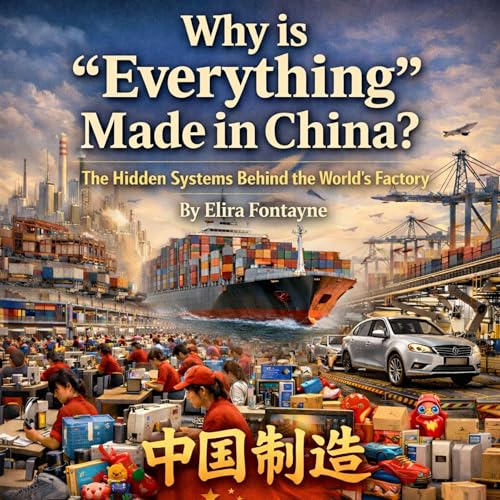
Why Is “Everything” Made in China?
The Hidden Systems Behind the World’s Factory
Failed to add items
Add to basket failed.
Add to wishlist failed.
Remove from wishlist failed.
Adding to library failed
Follow podcast failed
Unfollow podcast failed
3 Months Free

Why Is “Everything” Made in China?
Buy Now for £9.71
-
Narrated by:
-
Eyvonne Kinsey
-
By:
-
Elira Fontayne
You can tell a great deal about the modern world by turning an everyday object over in your hands and reading the small print.
A phone case, a kettle, a child’s toy, a set of headphones, a pack of socks, a kitchen timer, a car part, a rechargeable torch, a cable, a cheap drill, a Christmas decoration, a novelty mug, a watch strap, a hairdryer. The range is so ordinary that it becomes invisible. We barely register it anymore. Yet the phrase that appears again and again, stamped into plastic, etched into metal, printed on labels, or tucked into the corner of packaging, is not merely a place-name. It is a verdict on how the planet’s daily life is arranged.
Made in China.
For many people, it has become a background radiation of consumer culture. It is everywhere, so it stops feeling like anything at all. If we notice it, we treat it as a shortcut: cheap, fast, plentiful. If we dislike it, we treat it as a warning label: poor quality, imitation, disposable. If we feel uneasy, we treat it as a moral riddle: the price on the shelf versus the cost paid somewhere else.
But that little phrase is not the real story. It is the final stamp on a chain of decisions, policies, incentives, logistics, labour flows, corporate strategies, and geopolitical bargains that have been building for decades. It is not simply about one country being good at making things. It is about how modern capitalism and modern state power fused with modern supply chains to create something that, from the outside, looks almost impossible: a single manufacturing ecosystem so vast, so interconnected, and so fast that it can supply the daily material needs of billions of people.
©2026 Deep Vision Media t/a Zentara UK (P)2026 Deep Vision Media t/a Zentara UKListener received this title free
The strongest sections, in my opinion, are the ones that explain how different forces—governments, corporations, labor, and logistics—interact to create such an efficient manufacturing network. It’s not framed as a simple success story or a criticism, but as a layered system shaped by decades of decisions.
I also appreciated the writing style. It’s reflective without being slow, and analytical without becoming dense. The ideas build naturally, which makes it easier to follow even if you don’t have prior knowledge of economics or trade.
If I had one small critique, I would have liked a few more concrete case studies to go alongside the broader explanations. Still, it’s an insightful and well-structured exploration that leaves you thinking differently about the objects you use every day.
A Deep Dive Into the Invisible Infrastructure of D
Something went wrong. Please try again in a few minutes.
Listener received this title free
Makes You See Everyday Items Differently
Something went wrong. Please try again in a few minutes.
Listener received this title free
What stood out to me most was how the author frames ordinary products as the end result of a long and complex chain. It really changes how you think about something as simple as a phone accessory or a household item. The explanations are clear without being simplistic, and the narrative keeps you engaged even when discussing large-scale systems.
If I had one minor criticism, it’s that the pacing can feel a bit slow in places where the book dives into broader context. Still, that depth is part of what makes it valuable. It’s a well-researched, thought-provoking listen that gives you a much clearer understanding of how the modern world actually works behind the scenes.
A Thoughtful Look Behind the Label
Something went wrong. Please try again in a few minutes.
Listener received this title free
Breaks Down a Complex System Clearly
Something went wrong. Please try again in a few minutes.
Listener received this title free
It also connects everyday items to much bigger systems like global logistics, corporate strategy, and international trade networks. As I listened, I kept noticing how many small things in my own life are tied to massive global processes I never really thought about before.
If I had one small critique, I would’ve enjoyed a few more real-world behind-the-scenes examples. Still, as an overall listen, it’s clear, engaging, and genuinely changes how you think about everyday consumption.
A Clear, Thoughtful Breakdown of a Hidden Global S
Something went wrong. Please try again in a few minutes.