• GHG Inventory Credibility: Whats Actually at Stake
    Jun 30 2026

    Brian Schoening has spent the last four years as an independent sustainability consultant and GHG accounting specialist, working with mid-market companies to build credible, audit-ready inventories. Before that, he spent nearly 20 years at Northrop Grumman — one of the world's largest aerospace and defense companies — building and running their GHG accounting and corporate sustainability programs.

    In this episode, Brian pulls from both sides of that experience to walk through what actually goes wrong in GHG inventories, how to prevent it, and how to build the minimum viable inventory that's still defensible.

    We cover:

    • The missing-locations inventory: a real case study of a multi-year inventory that required a complete re-baseline

    • Why completeness failures are more common than clients expect — and how to catch them early

    • The three audiences every inventory management plan must serve: your internal team, future consultants, and auditors

    • Why precision is the enemy of efficiency in Scope 3 — and what a screening approach actually looks like

    • The fractional sustainability leader model: what it is, why mid-market companies need it, and the Fractional Sustainability Leaders Collective (fslcollective.com)

    • How Brian structures a portfolio of consulting services — fractional, carbon accounting, and project work — to manage the variability of independent practice

    Brian is founder of One Small Step Sustainability Consulting (onesmallstepsustainability.com) and The GHG Shop (ghgshop.com), and co-founder of the Fractional Sustainability Leaders Collective (fslcollective.com).

    Connect with Brian on LinkedIn: linkedin.com/in/brianschoening

    This episode is brought to you by North Star Carbon & Impact — the carbon and sustainability management platform built by sustainability professionals, for sustainability professionals. Visit northstarcarbon.com to learn more or request a demo.

    Show More Show Less
    33 mins
  • From One Winery to the World: How IWCA is Standardizing Wine Industry Carbon Accounting
    Jun 16 2026

    What if the hardest part of carbon accounting isn't the methodology — it's getting the right people to own the data?

    Fran Estartus, Operations Manager at the International Wineries for Climate Action (IWCA), has spent nearly a decade building expertise in wine industry carbon accounting. Before joining IWCA, she built the carbon program at VSPT Wine Group in Chile. Now she works with winery members representing 3.5% of global wine production across every continent.

    In this episode, Fran and Aaron cover:

    • Why carbon inventory failures are usually accountability problems, not methodology problems
    • The most overlooked Scope 3 risk for wine producers: purchased grapes and bulk wine
    • IWCA's new soil organic carbon sequestration standardization initiative
    • What separates wineries with robust, audit-ready inventories from those that struggle
    • Why "perfect can be the enemy of good" — and how to build a system designed to improve over time
    • How IWCA members share emissions data and best practices openly, despite being marketplace competitors

    Fran's implementation minute: spend 30 minutes mapping who owns the data for each major emission source. Carbon accounting becomes dramatically easier when data ownership is clear — and the 80/20 rule gets you most of the way there.

    Connect with Fran: LinkedIn — Fran Estartus Learn more about IWCA: iwcawine.org (free GHG calculator available for download)

    Brought to you by North Star Carbon & Impact — the carbon and sustainability management platform for sustainability professionals. Visit northstarcarbon.com.

    Show More Show Less
    33 mins
  • Sustainability Storytelling: The Four C's of Carbon Communication
    May 19 2026

    What do you do when you're not going to hit your 2030 sustainability goals?

    You could bury it in your sustainability report. Or you could call up your biggest critic and have an honest conversation. Mike Hower says PepsiCo chose the second option — and that's exactly why they're one of his best examples of sustainability communication done right.

    Mike Hower is the founder of Hower Impact, author of Sustainability Storytelling (Kogan Page, 2025), and host of the Sustainability Communicator podcast. He spent more than a decade as a journalist covering sustainability for GreenBiz, Sustainable Brands, and Triple Pundit before moving into communications strategy at Edelman and beyond. His clients include Mars, HP, and Berry Global.

    In this episode, Mike and Aaron cover:

    • The Four C's of effective sustainability storytelling: Context, Compelling, Credible, and Compliance

    • Why the best sustainability communicators don't have to say "sustainability" — the Fight Club rule

    • How to use layers of communication to make GHG data accessible without losing credibility

    • The approaching 2030 net zero reckoning and how to talk about missed goals without a credibility crisis

    • Why CEOs say they understand sustainability and still treat it as a cost center — and what to do about it

    • The one cross-functional action you can take this week to improve your sustainability communication

    Find Mike at Hower Impact, listen to the Sustainability Communicator podcast, and order Sustainability Storytelling wherever books are sold.

    This episode is brought to you by North Star Carbon & Impact — the carbon and sustainability management platform built by sustainability professionals, for sustainability professionals. Visit northstarcarbon.com to learn more.

    Show More Show Less
    51 mins
  • Wine, Glass, and Scope 3: Inside Spottswoode Estate's Carbon Journey
    Apr 28 2026

    Molly Sheppard is VP of Winery Strategies at Spottswoode Estate Vineyard & Winery in Napa Valley — a 37-acre, 20-person estate with one of the most rigorous sustainability programs in American wine. In her role, Molly oversees everything from winemaking to hospitality, direct sales, and sustainability — including six years of IWCA-verified Scopes 1–3 greenhouse gas inventories.

    In this episode, Molly takes us inside what carbon accounting looks like at a small but serious operation: how a first inventory can reveal a Scope 3 hotspot you can actually do something about, why "don't let perfect be the enemy of good" is the most important advice for practitioners struggling with Scope 3 data, and what it really takes to run a credible GHG program without a dedicated sustainability team.

    Topics include:

    • The glass lightweighting journey that took Spottswoode's estate Cabernet bottle from ~790g to 495g — driven directly by what the numbers revealed
    • Managing the cultural challenge of lightweighting in a luxury wine market where bottle weight equals perceived quality
    • Tools, timing, and practical strategies for running a Scope 3 inventory at a small business
    • Engaging your supply chain: why Scope 3 is hard now and what the future could look like when "your Scope 3 is somebody's Scope 1"
    • Regenerative organic farming, soil carbon sequestration, and what carbon neutrality could eventually mean for an estate like Spottswoode
    • The business case for environmental leadership — from operational cost savings to next-generation consumer loyalty

    Resources mentioned:

    • International Wineries for Climate Action (IWCA): iwcawine.org
    • The Wizard and the Prophet by Charles C. Mann
    • North Star Carbon & Impact: northstarcarbon.com

    Connect with Molly Sheppard:

    • Instagram: @mkshep | @spottswoode
    • Website: spottswoode.com

    This podcast is brought to you by North Star Carbon & Impact, the carbon and sustainability management platform built by sustainability professionals, for sustainability professionals. North Star helps companies simplify GHG accounting, improve data quality, and stay audit ready across Scope 1, 2, and 3 emissions so teams can spend less time reporting and more time driving real impact.

    Show More Show Less
    35 mins
  • Emissions Follow Dollars: How Finance Data Unlocks Better GHG Inventories
    Apr 14 2026

    Jaclyn Sherman's path into carbon accounting started in the field, monitoring water quality on the Yuba River, tracking aquatic invasive species, and working on meadow restoration and carbon sequestration projects in the Sierra foothills. That hands-on background now shapes how she approaches one of the most technical corners of sustainability work: GHG inventory assurance.

    Today Jaclyn is a Sustainability Analyst at Sensiba LLP, a top-100 U.S. accounting firm and the first California-based firm to earn B Corp certification. She leads GHG assurance engagements for food and beverage clients and has built her expertise through a combination of the GHGMI diploma program, deep on-the-job learning, and the kind of stay-curious adaptability that this rapidly evolving field demands.

    In this episode, Aaron and Jaclyn work through the distinction between verification, assurance, and validation; what data quality frameworks actually look like in an assurance engagement; and how readiness assessments help companies scope out where they stand before committing to a full inventory. They also build out a practical 90-day roadmap for a mid-sized food and beverage company trying to tackle Scope 3 Category 1 purchased goods, where 70% of purchases are agricultural commodities starting from scratch.

    The conversation also covers inventory management plans and the practical steps practitioners can take to future-proof their inventories through methodology changes, staff turnover, and evolving emission factors. And Jaclyn shares a candid take on how AI is showing up in GHG accounting work and what that means for assurance providers trying to evaluate data they can't fully trace.

    In This Episode:

    • The difference between verification, assurance, and validation in GHG work
    • How assurance providers evaluate data sources, data management frameworks, and methodology choices
    • What readiness assessments reveal and when they add the most value
    • A 90-day roadmap for Scope 3 Category 1 in agricultural supply chains
    • Inventory management plans and how to future-proof a GHG inventory
    • AI in GHG accounting: where it helps and where it complicates assurance
    • What doing sustainability work inside a B Corp accounting firm actually looks like
    • Career advice for practitioners at any stage: resources, the GHGMI diploma program, and learning on the job

    Resources Mentioned:

    • GHG Management Institute (GHGMI) Diploma Program: ghginstitute.org
    • Sustainability Simplified newsletter by Tim Mowin
    • Sensiba sustainability services: sensiba.com
    • North Star Carbon & Impact: northstarcarbon.com

    Connect with Jaclyn Sherman: LinkedIn: linkedin.com/in/jaclyn-sherman

    About the Podcast: The Carbon Management and Accounting Podcast is hosted by Aaron Stainthorp and sponsored by North Star Carbon & Impact, the carbon and sustainability management platform built by sustainability professionals, for sustainability professionals.

    This episode is brought to you by North Star Carbon & Impact. If you're looking for an easier, more transparent way to manage carbon and ESG data and prepare for audits, reporting, and decarbonization planning, visit northstarcarbon.com to learn more or request a demo.

    Show More Show Less
    31 mins
  • Before You Build a Decarbonization Plan, Check Your Baseline
    Mar 30 2026

    What happens when a company commits to a decarbonization plan — and then someone finally reviews the baseline?

    Dr. Albert Chung, Principal Engineer at GSI Environmental, has spent over 15 years verifying GHG inventories across industries. In this episode, he shares what verifiers actually see when they open an inventory for the first time, the red flags that show up before an audit even begins, and why so many decarbonization plans are built on foundations that were never independently reviewed.

    We also get into the practical side of inventory management: why companies that write their IMP at the deadline are setting themselves up for pain, how to think about materiality when your sustainability team is stretched thin, and the spend-based data problem — why switching to a lower-carbon supplier won't show up as a reduction if your baseline isn't built on actionable data.

    In this episode:

    • The red flags verifiers look for before the audit starts
    • Why inventory management plans should be built from day one, not written after the deadline
    • The 5% materiality threshold — and how it differs from what sustainability teams use internally
    • The spend-based trap: how your Scope 3 reduction initiatives can become invisible in your own reporting
    • Why starting in Excel might be the right move, even if you're planning to use software eventually
    • How to future-proof an inventory when methodology, regulations, and staff all keep changing

    About the Podcast: The Carbon Management and Accounting Podcast is hosted by Aaron Stainthorp and sponsored by North Star Carbon & Impact — the carbon and sustainability management platform built by sustainability professionals, for sustainability professionals. New episodes every other Tuesday.

    Learn more or request a demo: northstarcarbon.com

    Show More Show Less
    28 mins
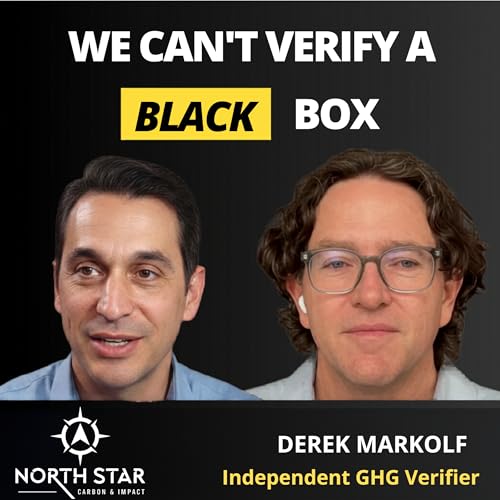
  • "We Can't Verify a Black Box" — What 22 Years of GHG Verification Reveals | Derek Markolf
    Mar 16 2026

    Derek Markolf spent 22 years at LRQA leading GHG verifications across manufacturing, agriculture, energy, and nearly every other sector. Now he runs his independent verification practice while slow-traveling the world with his wife — conducting verifications remotely from wherever they happen to be living that month.

    In this conversation, Derek shares what two decades of looking inside other organizations' GHG inventories actually teaches you — the patterns that show up everywhere, the mistakes that keep getting made, and the emerging issues that practitioners need to get ahead of right now.

    We cover:

    → Why the smallest sources are the biggest pain — and why this surprises first-time reporters every time

    → The "levers" problem: why spend-based and industry-average data removes your ability to show real emissions reductions

    → Base year recalculation — the most under-enforced GHG Protocol requirement, and why verifiers are giving it a lot more attention now that companies are nearing their target years

    → What inventory management plans need to contain to survive staff turnover

    → Why AI-assisted tools are creating a new challenge for verifiers: "We can't verify a black box"

    → What separates organizations that build solid, verification-ready inventories from those that struggle — and why it almost always starts with leadership commitment.

    🎙️ Carbon Management & Accounting Podcast | New episodes every other Tuesday

    Sponsored by North Star Carbon & Impact — northstarcarbon.com

    Show More Show Less
    32 mins
  • Mandi McKay - Sustainability at Sierra Nevada: Carbon Accounting from Barley to Beer
    Mar 3 2026

    Mandi McKay joined Sierra Nevada Brewing Company as a part-time sustainability coordinator — literally driving a forklift and collecting banana peels for the worm bin — and over 17 years grew into her current role as Chief Sustainability and Social Impact Officer. In this episode, she pulls back the curtain on what carbon accounting really looks like at one of America's most sustainability-forward breweries, including the honest story of their first Scope 3 inventory: a 25-tab spreadsheet that took over a year to complete and left her team swearing they wouldn't attempt it again for five years.

    We get into the practical realities of carbon accounting across the full beer supply chain — from barley farmers and energy-intensive maltsters to refrigerated cold chain logistics and packaging decisions. Mandi shares how materiality thinking has evolved from their first attempt in 2018 to today, how supplier conversations are actually shifting upstream data quality, and why Sierra Nevada's family ownership structure enables long-term sustainability bets that publicly traded companies simply can't make.

    Plus: the story behind Hop Forward — Sierra Nevada's sustainability campaign, annual impact report, and a beer that lets customers literally taste climate leadership.

    In This Episode

    • How Mandi grew from sustainability coordinator to C-suite over 17 years at Sierra Nevada

    • Why their first Scope 3 inventory took over a year — and what they do differently now

    • The carbon hotspots in beer: barley, malt, packaging, and refrigerated cold chain

    • How materiality thinking should guide Scope 3 data collection decisions

    • How supplier conversations are changing upstream data quality

    • The cold chain nuance most sustainability teams miss

    • How family ownership enables long-term sustainability investments

    • The Western North Carolina Brewery Recycling Cooperative and industry collaboration

    • Hop Forward: Sierra Nevada's sustainability platform, impact report, and annual beer

    Show More Show Less
    43 mins