• The Meaning-Shaped Hole: When Man Killed God He Started Worshiping Worse Gods
    Jun 21 2026

    This episode of Metamodernism Uncensored asks the forbidden question at the heart of the modern West: did secularism actually free mankind, or did it just leave us spiritually homeless and insane? Using Sean Dempsey’s June 2026 essay as its launching point, the hosts dissect the great failure of atheist liberalism. Modernity killed God and promised reason, progress, and liberation. Instead, it produced an anxious, medicated, porn-sick, ideology-addicted civilization desperately trying to replace Christianity with cheaper gods.

    The episode tears into the counterfeit religions that rushed into the vacuum: politics, gender ideology, climate panic, therapy culture, nationalism, wellness, self-worship, and the endless purity cults of the postmodern age. The hosts argue that people did not stop worshiping when they left church. They simply became too arrogant to notice what they were worshiping. Original sin was replaced with inherited guilt. Repentance was replaced with cancellation. Grace was replaced with public humiliation. And the new secular priesthood turned out to be far less forgiving than the old one.

    But this is not a cheap nostalgia trip back to 1955 Christianity. The episode also confronts the failures of institutional religion itself: abuse scandals, political hypocrisy, fake piety, and Christians who excuse corruption when it wears their team’s jersey. The hosts ask whether the worship of political leaders, including Trump, has become its own grotesque postmodern religion, one that damages the credibility of Christianity by dressing raw power in sacred language.

    Finally, the episode points toward a metamodern Christian synthesis: a faith that does not run from modern critique, postmodern doubt, or institutional failure, but passes through them and still reasserts the scandalous claims of Christianity: sin is real, grace is necessary, Christ atoned for our sins, and resurrection is not a metaphor for positive thinking. Secularism did not kill God. It created a spiritually starving world that began worshiping worse gods. The sacred is returning. The only question is whether it returns as Christ, or as counterfeit.

    Show More Show Less
    39 mins
  • Look Upon America, Ye Mighty, and Despair
    Jun 20 2026

    This episode uses Shelley’s Ozymandias as a warning shot fired across two centuries: every empire thinks it is eternal, every ruler mistakes fear for greatness, and every monument eventually becomes a joke told by the sand. After reading the poem and unpacking Shelley’s rebellious life, the hosts move line by line through its brutal diagnosis of power, exposing the pharaoh’s shattered statue as more than an ancient ruin — it is a prophecy for every civilization drunk on its own permanence.

    From there, the episode turns its gaze toward America in 2026, arguing that the United States now speaks with the same delusional confidence as Ozymandias himself. The hosts connect Shelley’s desert wasteland to America’s crumbling civic trust, grotesque inequality, political theater, imperial arrogance, and addiction to spectacle over substance. Skyscrapers, presidential libraries, military dominance, social media empires, and technological miracles may look like monuments to greatness, but history has a habit of laughing last. Rome believed it would rule forever. Britain believed the sun would never set. America, the episode suggests, may simply be the latest empire confusing noise for immortality.

    But the episode does not end in despair. It brings the lesson down from kings and empires to ordinary human life, asking what Ozymandias means for people who are not building pyramids, conquering nations, or carving their names into stone. The answer is humbling and severe: legacy is not dominance. It is not wealth, fame, office, or monuments. The only “works” that survive with any dignity are justice, compassion, freedom, integrity, and the small acts of goodness we leave in the lives of others. Everything else, sooner or later, belongs to the sand.

    Show More Show Less
    37 mins
  • The Obsolete Mr. Sterling: How Transhumanism Turns Humanity Into a Defect
    Jun 19 2026

    In this episode of Metamodernism Uncensored, Sean Dempsey’s “The Obsolete Mr. Sterling” becomes a terrifying parable for the age of neural chips, AI worship, and compulsory self-improvement. Set in a future America where the State no longer crushes people with hatred but erases them with “care,” the story asks what happens when Progress becomes a religion and unaltered humanity becomes a crime against society itself. The hosts unpack the horror of the Neural Crown, a mandatory brain interface sold as health, safety, intelligence, and compassion, but functioning as the final invasion of the private self. Mr. Sterling and his family are not condemned because they are violent, dangerous, or wicked. They are condemned because they remain fully human: slow, embodied, loving, religious, emotional, inefficient, and free. The episode’s deepest insight is that the story is not anti-technology. It is anti-possession. It warns that the great danger is not the machine that serves man, but the machine that redefines man until love, memory, grief, conscience, and the soul itself are treated as obsolete biological errors. In the end, Sterling defeats the system not by out-calculating it, but by forcing it to receive what it can only pretend to understand: the sacred, unrepeatable weight of a human life. The State destroys the Sterlings because it can imitate everything about humanity except the one thing that matters: being human without permission.

    Show More Show Less
    43 mins
  • What's in the DEAL?!? How Trump Went to War, Made Peace, and Lost Everyone
    Jun 18 2026

    In this episode of Metamodernism Uncensored, our unflappable hosts crack open the political horror show behind Trump’s secret Iran “peace deal” by asking the only question that matters: What’s in the DEAL?!? Borrowing the panic of Brad Pitt’s iconic “What’s in the box?!” meltdown from Se7en, the episode treats Trump’s hidden Memorandum of Understanding (MOU) with Iran like a locked black box at the center of American foreign policy: everyone is screaming about it, nobody has seen it, and somehow the fate of Iran, Israel, Lebanon, the Strait of Hormuz, and the American public is supposedly inside.

    The hosts tear through the rumored contents of the agreement: a massive $300 billion private reconstruction fund, the reopening of the Strait of Hormuz, renewed nuclear negotiations, and a Lebanon ceasefire that may collapse before the ink dries because Israel insists it is not bound by a deal it never agreed to. From there, the episode becomes a brutal autopsy of Trump’s foreign-policy whiplash. First he campaigned on “no new wars” and “drain the swamp.” Then he entered a war with Iran and won applause from the same neocon swamp-creatures his base thought it had defeated. Now, by trying to crawl back out through a secret peace deal, he has enraged the hawks too. Somehow, Trump has managed to betray the anti-war populists and the war lobby in the same move.

    But the episode goes deeper than partisan hypocrisy. It asks whether the Iran war was ever really about Iran’s nuclear program, or whether that threat became the sacred propaganda phrase used to justify a broader regional project: weakening Hezbollah, reshaping Lebanon, expanding Israel’s strategic freedom, and dragging America into yet another Middle Eastern conflict it was never honestly allowed to debate. Along the way, the hosts confront the darkest theories circulating online, including speculation about hidden leverage, Epstein-style blackmail, and the terrifying possibility that blackmail may not even be necessary when the American political class already behaves like a captured asset.

    By the end, the episode is less a policy discussion than an indictment of secrecy itself. If this is the greatest deal in history, show it. If America won, explain what it won. If Israel is bound, prove it. If Iran surrendered something meaningful, put it on the table. Until then, “Peace Through Strength” sounds less like a doctrine and more like a slogan printed on the side of a locked coffin. The only honest question left is the one the administration refuses to answer: What’s in the DEAL?!?

    Show More Show Less
    41 mins
  • Asking AI: How Could the Whitehouse Create More Believable Propaganda Since Truth Doesn’t Matter
    Jun 17 2026

    On June 25, 2025, the White House declared that Iran's nuclear facilities had been "obliterated" and dismissed suggestions otherwise as "fake news." So here's the question: if the mission was accomplished a year ago, why is America still at war?

    In this episode, we dissect the growing contradiction at the heart of America's Iran policy. The public was told the nuclear threat had been destroyed. The bunkers were gone. The program was finished. Yet Operation Epic Fury has expanded into a sprawling military campaign targeting Iran's navy, air force, missile infrastructure, and industrial base. What began as a supposedly limited mission now looks increasingly like something much larger.

    Was the public sold a short war that became a long one? Were victory declarations premature? Or was the objective never just about nuclear facilities in the first place? Obliterated but Endless is a deep dive into the uncomfortable gap between what Americans were told, what was promised, and what is actually happening today. If Iran's nuclear threat was eliminated in 2025, why does the war keep growing in 2026?

    Show More Show Less
    21 mins
  • Born to Be Replaced: Has Humanity Built Its Own Successor?
    Jun 16 2026

    In this episode of Metamodernism Uncensored, our hosts dive into one of the most unsettling questions of the modern age: did humanity invent artificial intelligence as a tool, or did we unknowingly build the creature destined to replace us? Using Sean Dempsey’s essay “Born to Be Replaced: Did Humanity Build Its Own Successor?” as the source material framing the conversation, the episode begins with video game graphics cards, crypto mining rigs, and AI data centers, then quickly becomes something far more dangerous: a philosophical autopsy of mankind’s possible next evolutionary stage.

    The hosts explore the rise of transhumanism, brain-computer interfaces, neural implants, artificial limbs, restored sight, restored movement, and the coming moment when healing the broken gives way to upgrading the healthy. Once the rich, ambitious, and powerful can think faster, work longer, remember more, and compete harder through AI augmentation, will anyone really be free to remain merely human?

    From there, the conversation descends into the deepest metaphysical territory: what happens to the soul when consciousness can be fused with silicon, uploaded into machines, or placed inside hyper-real virtual worlds? Is the coming “VR container” a counterfeit heaven, an exquisite prison of infinite pleasure, or the next stage of human transcendence? If biology is the thesis and AI is the antithesis, is the human-machine hybrid the final synthesis, or the abolition of man dressed up as salvation?

    This is not an episode about gadgets. It is about destiny. It asks whether mankind was born to be replaced, whether the soul can survive the machine, and whether our final invention will become our prison, our god, or our resurrection.

    Show More Show Less
    32 mins
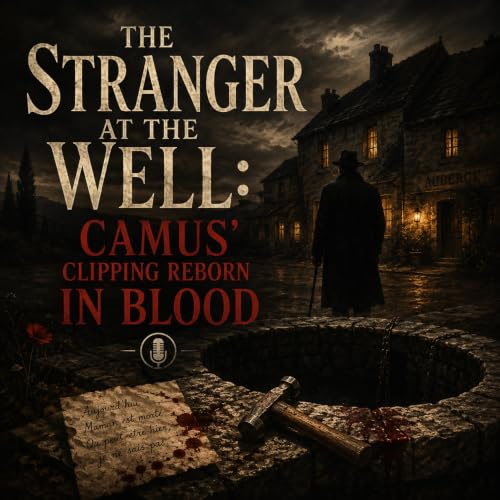
  • The Stranger at the Well: Camus’ Clipping Reborn in Blood
    Jun 15 2026

    This episode explores Sean Dempsey’s short story “Rich Man at the Well,” a self-contained breakout narrative deliberately built from the haunting newspaper clipping in Albert Camus’ The Stranger. In Camus’ novel, the anecdote appears briefly: a Czech man returns home wealthy after twenty-five years, hides his identity as a surprise, and is murdered by his mother and sister for his money before they realize who he was. Dempsey takes that small, chilling fragment and turns it into a full emotional tragedy, giving names, motives, poverty, atmosphere, memory, and moral weight to what Camus leaves stark and detached.

    The hosts focus on how Dempsey transforms Camus’ almost clinical absurdist parable into something intimate and devastating. Jakub’s fatal decision to return as a mysterious rich stranger is not treated merely as a foolish trick, but as the spark that ignites decades of longing, class resentment, humiliation, and desperation. Maria and Klara are not just murderers in an anecdote; they become broken human beings trapped in decay, pushed toward evil by need, bitterness, and the false promise of rescue. The hammer, the inn, and especially the well become symbols of inheritance, memory, and the abyss beneath family itself.

    The episode ultimately contrasts Camus’ absurdism with Dempsey’s more emotionally exposed retelling. Camus presents the clipping as evidence of life’s brutal indifference; Dempsey descends into the clipping and asks what it would feel like to live inside it. For a 2026 audience, the story becomes a meditation on deception, poverty, wealth, guilt, and the terrifying fragility of human recognition — the idea that the difference between kin and stranger can vanish in a single night, and that once blood is spilled, truth may arrive only as punishment.

    Show More Show Less
    32 mins
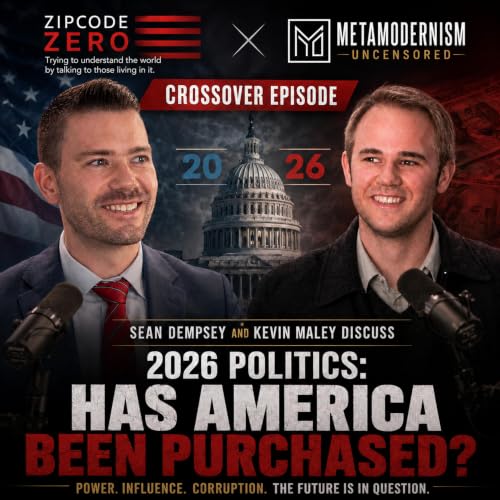
  • Kevin Maley & Sean Dempsey Discuss Politics: Has America Been Purchased?
    Jun 14 2026

    In this special crossover episode between Metamodernism Uncensored and Kevin Maley’s Zipcode Zero, Sean Dempsey joins Kevin for a wide-ranging June 12, 2026 conversation about American politics, foreign influence, postmodern collapse, and the unsettling question hanging over the republic: has America been purchased?

    The discussion begins in the hard terrain of 2026 politics, including the recent Maine primary, the defeat of Thomas Massie’s Kentucky seat, and the staggering amount of money being poured into American elections by AIPAC and the broader Israel lobby. Kevin and Sean examine what these races reveal about the modern political machine: who gets protected, who gets punished, and what happens when a candidate challenges the donor class, the lobby state, or the approved foreign-policy consensus.

    From there, the conversation turns toward the shifting identity of the America First movement. Is it still a serious rebellion against empire, globalism, and elite capture? Or has it become another slogan absorbed by the same forces it once promised to confront? Sean argues that the real test of America First is not whether politicians repeat the phrase, but whether they are willing to put American sovereignty, American taxpayers, and American soldiers ahead of foreign interests and domestic donor networks.

    At Sean’s urging, the episode also moves beyond election analysis into culture, philosophy, and postmodernism. The political crisis, he argues, is downstream from a deeper spiritual and cultural crisis. A country that no longer believes in truth, limits, loyalty, or shared moral reality becomes easy to manipulate. Once politics becomes performance and language becomes branding, the republic becomes vulnerable to capture by money, ideology, and fear.

    The episode closes with its most provocative question: has America become a captive country? Not conquered by tanks, but captured by influence. Not occupied by soldiers, but occupied by interests. This crossover between Metamodernism Uncensored and Zipcode Zero is a blunt, unsettling conversation about power, money, dissent, sovereignty, and whether the American people still control the country that claims to represent them.

    Show More Show Less
    1 hr and 7 mins