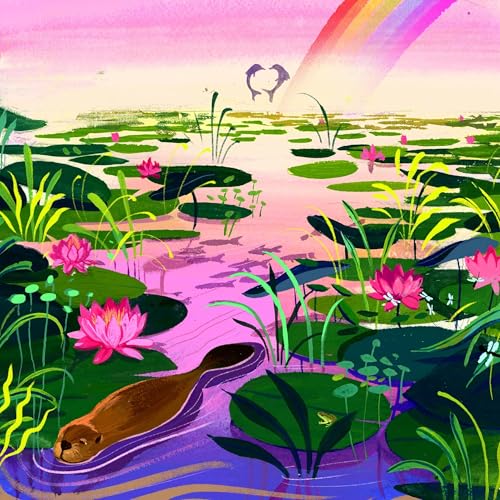
Radiolab cover art

Radiolab

Radiolab

By: WNYC Studios
Listen for free

About this listen

Radiolab is on a curiosity bender. We ask deep questions and use investigative journalism to get the answers. A given episode might whirl you through science, legal history, and into the home of someone halfway across the world. The show is known for innovative sound design, smashing information into music. It is hosted by Lulu Miller and Latif Nasser.© WNYC Studios Nature & Ecology Science Social Sciences World
Episodes
  • The Builders
    Apr 10 2026
    In an episode first aired back in 2025 on our sister show, Terrestrials, we take you on a musical journey all about beavers. Few mammals have a bigger positive impact on the planet than the beaver. With its bright orange buck teeth, the creature is an expert engineer that brings life wherever it waddles and even fights fires. Our story begins in the Bronx river, once known as the “open sewer” of New York City. After some humans decide to clean it up, we meet one of the river’s residents - José the beaver. We learn about the US government parachuting beavers out of planes into the mountains. And finally head to California where we discover how one beaver family saved acres of land from burning. Special thanks to author Ben Goldfarb, Christian Murphy from the Bronx River Alliance and Dr. Emily Fairfax. Terrestrials was created by Lulu Miller with WNYC Studios. This episode was produced by Ana González and sound-designed by Mira Burt-Wintonick. Our team includes Alan Goffinski, Joe Plourde and Tanya Chawla. Fact checking was by Diane Kelly. Our advisors for this show were Ana Luz Porzecanski, Nicole Depalma, Liza Demby and Tovah Barocas. EPISODE CITATIONS: Books - Eager: The Surprising, Secret Life of Beavers and Why They Matter (https://zpr.io/4QLuhrSMfurk), by Ben GoldfarbBeaverland: How One Weird Rodent Made America (https://zpr.io/3BbaViJK8Hk3), by Leila Philip’s Videos - Watch the US government drop beavers out of planes (https://zpr.io/y2JJPwwyr3Bp). Watch Leave It to Beavers (https://zpr.io/JVGZYmNCTy6h), a documentary about beavers restoring rivers and wetlands. Articles - How reintroducing beavers can enhance ecological health (https://zpr.io/KNxz3MtKL9sV), by Madison Pobis, Stanford Report.Beaver Dams Help Wildfire-Ravaged Ecosystems Recover Long after Flames Subside (https://zpr.io/kAnjEUPvPUeJ), by Isobel Sandcomb, Scientific American HEY GROWN-UPS! Love the show? Leave us a ⭐⭐⭐⭐⭐ rating and review on your podcast app—it helps curious listeners find us! We want to hear from you! Share your thoughts about Terrestrials with us.Subscribe to our weekly newsletter for bite-sized essays, activities, and ways to connect with the show.Follow us on YouTube, Instagram, and TikTok for behind-the-scenes extras and more.Listen to original music from Terrestrials on Spotify, Apple Music, or our music page. Got a badgering question for the team? Email us at terrestrialspodcast@wnyc.org or submit a voice memo with your name, age, and your question using this form! Terrestrials is made possible in part by listeners like you. Support the show by joining Radiolab’s membership program, The Lab—and we’ll send you a special thank-you gift from our team!Leadership support for Radiolab’s science programming is provided by the Simons Foundation and the John Templeton Foundation. Foundational support for Radiolab was provided by the Alfred P. Sloan Foundation.
    Show More Show Less
    30 mins
  • Life in a Barrel
    Apr 3 2026

    This week, in an episode we first aired in 2022, we flip the Disney story of life on its head thanks to a barrel of seawater, a 1970s era computer, and underwater geysers. It’s the chaos of life.

    Latif, Lulu, and our Senior Producer Matt Kielty were all sitting on their own little stories until they got thrown into the studio, and had their cherished beliefs about the shape of life put on a collision course. From an accidental study of sea creatures, to the ambitions of Stephen J Gould, to an undercooked theory that captured the world’s imagination, we undo the seeming order of the living world and try to make some music out of the wreckage. (Bonus: Learn how Francis Crick really thought life got started on this planet).

    EPISODE CREDITS:
    Reported by - Latif Nasser, Matt Kielty, Heather Radke, Lulu Miller and Candice Wang
    Produced by - Matt Kielty and Simon Adler
    with help from - Arianne Wack
    Original music and sound design contributed by - Matt Kilety, Simon Adler, Alan Goffinski, and Jeremy Bloom

    EPISODE CITATIONS:

    Articles -

    • Chaos in a long-term experiment with a plankton community (https://zpr.io/j6sYXKfDzPCG), by Benincà, E., Huisman, J., Heerkloss, R. et al. Nature
    • Chaos theory discloses triggers and drivers of plankton dynamics in stable environment (https://zpr.io/qHKENA3SJ8ML), by Telesh IV, Schubert H, Joehnk KD, Heerkloss R, Schumann R, Feike M, Schoor A, Skarlato SO. Sci Rep.

    Books -

    • Full House (https://zpr.io/pMQZfyPcRzD4), by Stephen Jay Gould
    • Extinction: Bad Genes or Bad Luck? (https://zpr.io/pPVNugUKWpi4), by David M. Raup
    • Rereading the Fossil Record: The Growth of Paleobiology as an Evolutionary Discipline (https://zpr.io/YBjJxuXjydPN), by David Sepkoski
    • The Vital Question: Energy, Evolution, and the Origins of Complex Life (https://zpr.io/LzfueEqUWNHb), by Nick Lane
      Life Itself: Its Origin and Nature (https://zpr.io/KPZf57eEVMBX), by Francis Crick

    Signup for our newsletter!! It includes short essays, recommendations, and details about other ways to interact with the show. Sign up (https://radiolab.org/newsletter)!

    Radiolab is supported by listeners like you. Support Radiolab by becoming a member of The Lab (https://members.radiolab.org/) today.

    Follow our show on Instagram, Twitter and Facebook @radiolab, and share your thoughts with us by emailing radiolab@wnyc.org.

    Leadership support for Radiolab’s science programming is provided by the Simons Foundation and the John Templeton Foundation. Foundational support for Radiolab was provided by the Alfred P. Sloan Foundation.

    Show More Show Less
    55 mins
  • Antibiotic Apocalypse
    Mar 27 2026

    Doctor and special correspondent Avir Mitra takes Executive Editor Soren Wheeler, plus a live studio audience, on a journey from the operating room to inside the body to the farm to the sewers and back again—searching for answers to an alarming threat to humanity’s existence as we know it: antibiotic resistance in bacteria.

    This live show, performed in New York City and also in Little Rock, Arkansas, is part of a series we’re doing with Avir that we are calling “Viscera.” Each event is a conversation that takes the audience on a journey into a quirk or question or mystery inside of us, and gives them a visceral experience of the viscera within us. The previous installment of the series was called “The Elixir of Life.” (https://radiolab.org/podcast/the-elixir-of-life)

    Special thanks to all of Little Rock Public Radio (especially Grace Zafasi and Jonathan Seaborn), Thomas Patterson, The Greene Space staff, CALS Ron Robinson Theater, Tom Philpott, Stephen Roach, Kate Shaw, Alex Wong, Maryn McKenna, and Kerri McClimen.

    If you are a patients or a doctor, and you are interested in phage therapy, please contact IPATH@ucsd.edu

    EPISODE CREDITS:
    Reported by - Avir Mitra
    Produced by - Jessica Yung
    Sound design contributed by - Jeremy Bloom and Jessica Yung
    Fact-checking by -Natalie Middleton

    EPISODE CITATIONS:

    Videos -

    • Check out the video from the Viscera live show (and a bonus Q&A with Bruce Stewart-Brown and Steffanie Strathdee) on Radiolab’s YouTube (https://zpr.io/3BK9MqJYVKQA).
    • A deep dive (https://zpr.io/WNQNfgiNvKeZ) on bacteriophages with Avir Mitra and Steffanie Strathdee, also on Radiolab’s Youtube..

    Books -

    • The Perfect Predator (https://theperfectpredator.com/) by Dr. Steffanie Strathdee’s telling of her battle against a killer superbug.
    • Plucked (https://zpr.io/PudGMEuzgU9X) by Maryn Mckenna a detailed accounting of chicken farming’s practice of using antibiotics.

    Signup for our newsletter!! It includes short essays, recommendations, and details about other ways to interact with the show. Sign up (https://radiolab.org/newsletter)!

    Radiolab is supported by listeners like you. Support Radiolab by becoming a member of The Lab (https://members.radiolab.org/) today.

    Follow our show on Instagram, Twitter and Facebook @radiolab, and share your thoughts with us by emailing radiolab@wnyc.org.

    Leadership support for Radiolab’s science programming is provided by the Simons Foundation and the John Templeton Foundation. Foundational support for Radiolab was provided by the Alfred P. Sloan Foundation.

    Show More Show Less
    1 hr and 1 min
All stars
Most relevant
Original material, excellently presented and engaging. I need a few more words, so here they are.

A fantastic podcast

Something went wrong. Please try again in a few minutes.