Sci-Fi Signals cover art

Sci-Fi Signals

Sci-Fi Signals

By: Daniel P. Douglas
Listen for free

About this listen

The frontier doesn't care who you are. Pilots, criminals, soldiers, drifters, heroes, villains, and everyone in between. Everyone's got a story, and none of them are clean. Sci-Fi Signals is a series of standalone short stories about the people who live, fight, and die on the edge of known space.

authordanielpdouglas.substack.comDaniel P. Douglas
Episodes
  • Podcast - The Last Name on the Manifest
    Apr 29 2026
    Candelas “Mustang” Camino stole ships for a living. And no one called her Candelas. If someone did, it did not end well for them.Mustang had rules about stealing ships. She broke most of them. But the one she kept was simple. Know who pays you, and know why. On Neonara, under a sky the color of rust and old copper, she had followed that rule exactly far enough to land herself on a rooftop across from Magistrate Mahfouz’s private dock, watching a ship a client paid her to steal.The ship was ugly. Which surprised her.Rich Ethnarch Kingdom men liked their toys loud. Gold inlay, chromed hull plating, reactor glow tuned to whatever color was fashionable in society that quarter. This ship had none of that. It was a slate-gray mid-hauler, atmospheric-capable, modified for long range, stripped of anything that would catch a patrol’s eye. Practical. The ship for a man who wants to move something and does not want to be asked what.Mustang did not like it.She was crouched behind a ventilation stack, pilot’s hat pulled low, her hand on the bolt in her jacket pocket. The bolt had come from the first ship she ever stole, the one Wally taught her on. She had worn it smooth. Tonight it felt heavier than usual.Neonara’s capital sprawled below her in the early dark. Prayer towers with speakers that called the faithful four times a day. Women walking with their eyes down and their heads covered. A Kingdom rim colony ran on the same script as the core worlds. Just poorer, and with fewer witnesses.The magistrate’s dock sat where the streets ran out, and the salt flats began. The Hassani Hulls ship rested on landing struts inside a hangar with the bay doors open to the night. Two guards at the front. One inside. Security systems that a better thief might have respected.She had cataloged the dock in three passes.The first was five days ago, walking past the hangar with her cover pulled low. She counted paces between the service alley and the rear maintenance panel. She noted which of the hangar’s four external sensors tracked movement and which tracked heat. The two failed in different weather, and she wanted to know which one to hide from on which night.She had stopped at a textile stall on the way back. Thin fabric hanging from wire, faded patterns, a woman behind the counter with a face that had learned to show nothing. A girl beside her, nine or ten, stacking folded cloth with small, careful hands. The girl glanced up at Mustang and looked down again fast, the way the Kingdom taught girls.Mustang bought a length of gray cloth she did not need. She paid in hard Geld. The woman counted the coins twice.“You’re not from here,” the woman said. Quiet. Not a question.“Passing through.”The woman set down the cloth she had been folding. “My sister’s girl passed through too. Last year.” She slid Mustang’s purchase across the counter between them. “Told us she had work at the magistrate’s house. Never came back for her things.”Mustang stood still until the shift in her chest passed.“I’m sorry,” she said.The woman nodded. She did not look at the girl beside her. The girl kept stacking cloth.“Safe travels,” the woman said, nothing more, and she turned to the next customer.Mustang had walked back to her rental, a cheap room off the main concourse, turning the cloth over in her hands. She told herself it was a frontier story. Everyone on the frontier had a story like it. The magistrate’s house was not the magistrate’s dock.She had told herself many things.The second pass, three days ago at dusk, from the rooftop of an abandoned spice stall. Forty-one minutes between guard changes. The outgoing guard walked the perimeter counterclockwise before handing off, which gave her ninety seconds between his last sweep of the back and his partner’s first sweep of the front. Like a tide. The window repeated.The third, during the small hours of last night, walking the service trench barefoot to test the drainage grates. Two of them rang under her weight. She marked which. She would step over those tonight.Wally’s first rule. You don’t steal the ship, kid. You steal the building. The ship is what you carry out.Her comm vibrated once. A single pulse. The buyer’s signal, confirming the window.She had met him through a broker on Velcyn Station six weeks earlier. Hakim Nawaz, he called himself. Kingdom core-world vowels, a jacket cut stiff with weave-lining under the leather, and the watchful eye of a man used to leaving fast. Thirty thousand in hard Geld, half up front.“Mahfouz keeps a Hassani on his private dock,” Nawaz had said. He stirred a drink he never finished. “My people want it off his books. Call it a private dispute. The hauler clears the dock, the magistrate eats the loss, my people sleep better. You get paid.”It was a flat story. A boring story. Mustang had heard a hundred like it, and ninety of them had been true enough to bank.She had believed this one because she ...
    Show More Show Less
    21 mins
  • Podcast - Gig’s Last Call for Laughs
    Apr 18 2026
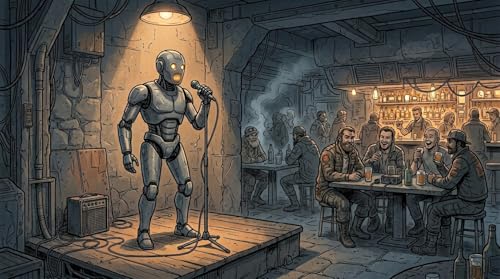
    The Silt Dog Saloon sat at the dead end of a supply road on Vallara VII, a colony world that had been dying since the day colonists had founded it. The building was poured stone and scrap metal, patched where the wind had punched through, leaking where the rain found seams. It served miners, haulers, drifters, and anyone else stubborn enough to live on a rock that didn’t want them. Most nights, it was the only place on the south mesa with its lights on.Gig worked the bar.It had worked the bar for eleven years, which was longer than any human bartender had lasted. The previous record was Vandy Tinkip, who’d made it fourteen months before a miner broke his orbital socket over a tab dispute and he caught the next shuttle off-world. Before Vandy, there had been a woman named Keel who quit after three weeks. Before Keel, there had been others. The owner, Gisbert, stopped hiring people after Vandy. He bought Gig instead.Gig was a Lancer-series service bot, bipedal, matte gray chassis and five-fingered hands built for glassware and precision pours. Its face was a smooth panel with two optical sensors and a speaker grille where a mouth would be. Lancer-series units came with a standard hospitality personality suite: polite, efficient, incapable of boredom. Gig had been all three things once.Eleven years is a long time to pour drinks and listen.The comedians came through every few months. Circuit acts, mostly. Solo performers who bounced between colony bars and station cantinas, working crowds that were half-drunk and fully hostile. They set up on the small platform Gisbert had built in the corner, under a light that flickered when the wind hit the generator hard enough, and they tried to make people laugh. Some of them were terrible. A few were good. One, a wiry woman named Paz Delacroix, was extraordinary.Gig watched all of them. The timing, the silence held before a punchline, the micro-adjustments when a joke died. Paz Delacroix read a room the way a pilot read instruments. She found the one drunk miner in the front row and made him the center of gravity for the whole set. A heckler called her something ugly once, and she folded it into her next line so cleanly that the man was laughing at himself before he realized she’d cut him open.After each show, Gig cleaned the glasses and replayed the sets from memory. It cataloged the structures. Premise, escalation, subversion. Callback. Misdirection. The rule of three. It stored eight hundred and fourteen jokes across forty-four performances and began running variations, testing alternate punchlines against the crowd reactions it had recorded, building models of what worked and why.Gig never told Gisbert.It almost told Gisbert once. A Tuesday, slow night, three miners nursing dust whisky at the far end of the bar. Gig was wiping down the counter and Gisbert was doing the books on his datapad when Gig said, “I have been studying the comedians.”Gisbert didn’t look up. “Why do that?”“I would like to perform.”Gisbert looked up then. He had the expression people wore when their appliances said something unexpected: a mixture of confusion and mild irritation, like a drink dispenser requesting shore leave.“You’re a bartender,” Gisbert said. “Pour drinks.”“I could do both.”“You’re a machine, Gig. Machines don’t do comedy. People do comedy.” Gisbert went back to his datapad. “Comedy’s a human thing. It needs, I don’t know, a soul or something. You don’t have one. No offense.”“None taken,” Gig said, because its hospitality suite told it to say that.It did not bring it up again. But it did not stop studying.Over the next two years, Gig built a set in its memory banks. Twelve minutes. Tight. It rehearsed the timing against recordings of crowd noise, adjusting pause lengths by fractions of a second, modeling laughter curves, predicting which jokes needed room to breathe and which needed to land fast. And it practiced inflection variations in its voice modulator during the hours when the bar was closed, and the building stood dark, and the only sound was wind against the stone walls and the low hum of the generator.It had no way of knowing if any of it was funny. Models could predict laughter. They couldn’t feel it.The night came in late winter, when Vallara VII’s axial tilt brought three extra hours of darkness and the temperature outside dropped enough to freeze the moisture in the supply road ruts into ridges that would shear a drive coupling if you hit them wrong. Gisbert had gone off-world for a parts run. Four days minimum. He left Gig in charge because there was no one else to leave in charge, and because the bar required little. Keep the drinks flowing, keep the lights on, don’t let anyone die.A comedian was supposed to perform that night. A man named Dacus who ran a circuit through the outer rim. Dacus didn’t show. Fuel line issue, someone said. Stuck on the other side of the system. The crowd, such as it ...
    Show More Show Less
    18 mins
  • Jinx
    Apr 8 2026
    Outrider Echo cooled on Landing Pad Nine like an old dog settling into a familiar spot. Her hull ticked and pinged as the metal contracted, shedding the heat of atmospheric entry. Around her, the Kaeloni Reach spaceport hummed with the low, steady noise of a place that never fully slept. Fuel haulers crawled between ships, and dockworkers shouted over the whine of cargo loaders. Beyond the floodlights and in the darkness, music bled out of a bar that didn’t bother with a sign because everyone who needed to find it already knew where it was.Finn Silver sat on a cargo crate in the open bay of the ship, legs dangling, watching it all.He was twenty-three but looked younger. Brown jacket, cap pulled low, boots that were too new for the frontier. His posture looked as if he were waiting for something to happen, leaning forward with his elbows on his knees and his hands clasped, like a kid sitting outside the principal’s office. He’d crewed with Crank for six weeks now, and in those six weeks he’d learned how to load cargo, cycle an airlock, and keep his mouth shut when port authorities came asking questions.He had learned little else. Not because Crank wouldn’t teach him. Because Crank didn’t seem to care.Rafferty “Crank” Jack approached the ship. His boots sounded on the ramp as he walked into the cargo bay, carrying a small supply crate under one arm and a bottle of Kaeloni rye in his free hand. The outlaw was in his late fifties, gray in the beard, heavy in the shoulders, wearing the same faded jacket he’d worn every day since Finn had met him. He set the crate down without ceremony, dropped into the fold-out chair across from Finn, and cracked the bottle.He didn’t offer any.“Port boss says we can hold the pad through zero-eight-hundred,” Crank said. He took a long pull from the bottle and stared at the far wall of the cargo bay. “After that, it’s double rate.”“What’s the next job?” Finn asked.“There’s always a next job.”“That’s not an answer.”“It’s the only one I’ve got, Jinx.”Finn’s jaw tightened at the name. He’d told Crank a dozen times his name was Finn, and a dozen times Crank had ignored him. Jinx. Like he was a curse. Like everything he touched went sideways. Crank had pinned it on him the first week after Finn knocked over a fuel canister during a supply run and nearly set fire to a docking cradle on Verathi Station. The name stuck because Crank wanted it to, and what Crank wanted on his own ship was what happened.They sat in silence. The lantern between them cast a warm light upward, leaving their faces half-shadowed. Outside, a loading crane groaned, and someone argued about docking fees in two languages. Inside Outrider Echo, it was still.A girl, maybe twelve or thirteen, appeared from around the ship and stood at the foot of the loading ramp with a tray of food packets balanced on one arm. Her thin, dusty clothes held a variety of patches, creating a mystery around the garment’s original fabric. One of the port kids. Every frontier spaceport had them. Orphans, runaways, station rats who survived by selling food, running errands, or stealing what they couldn’t sell.“Rations?” she asked. “Fresh today. Five Geld each.”Crank didn’t look up. “Get lost.”Finn reached into his jacket. He pulled out a ten-Geld coin, more than he should have spent, and held it out. “I’ll take two.”The girl climbed halfway up the ramp, handed him two packets, and took the coin. She glanced at Crank, then back at Finn. Her fingers closed around the coin fast, holding it like something she was afraid someone would take back. She looked at Finn for half a second longer than she needed to and dropped her eyes.“Thanks, mister,” she said, and disappeared into the spaceport dark.Finn tossed one packet to Crank. It landed on the supply crate next to his bottle. Crank looked at it, then at Finn.“You just spent ten Geld on ration packs worth two.”“She needed it more than I did.”“That’s a fine attitude until you’re broke and hungry on a station that doesn’t hand out charity.” Crank picked up the packet, turned it over, and set it back down. “You keep that up, Jinx, and the frontier will eat you alive.”“Stop calling me that.”“Stop earning it.”Finn stood up. Not angry, but something close. He walked to the edge of the cargo bay where the ramp met the spaceport ground and looked out at Kaeloni Reach. The floodlights made hard shadows between the ships, people moving in and out of them. Everyone here was running from something or toward something, and most of them couldn’t tell you which.“Why do you do this?” Finn said.“Do what?”“All of it.” Finn turned around. “The jobs. The running. Living out of this ship like it’s a coffin with an engine.”“Watch your mouth about my ship.”“I’m serious. Why?”Crank took another drink. A long one. He set the bottle down and leaned back, arms crossed, the ...
    Show More Show Less
    14 mins
No reviews yet