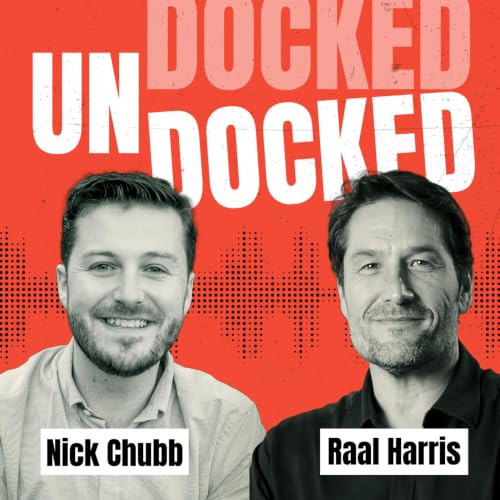
UnDocked: The Maritime Transformation Show cover art

UnDocked: The Maritime Transformation Show

UnDocked: The Maritime Transformation Show

By: Raal Harris and Nick Chubb
Listen for free

Summary

Undocked is a weekly podcast where Nick Chubb and Raal Harris explore what’s changing in maritime and technology. Through candid conversations and guest interviews, the show unpacks emerging trends, overlooked stories, and strategic insights, offering a fresh, unfiltered perspective on the evolving future of one of the world’s oldest industries.2026 Raal Harris and Nick Chubb
Episodes
  • FuelEU Pooling, Carbon Markets, and Regulatory Fragmentation with Friederike Hesse
    May 14 2026

    Zero44 founder Friederike Hesse joins Undocked to unpack the operational reality of maritime decarbonisation compliance. From FuelEU pooling and EU ETS accounting to the unintended consequences of CII, the discussion explores how regulation is reshaping commercial shipping — and why software is rapidly becoming essential infrastructure for managing complexity.

    • 00:38 Introducing Friederike Hesse and Zero44
    • 02:15 From startups and consulting into maritime
    • 04:34 Lessons from scaling Homeday
    • 07:36 Why maritime decarbonisation became a software problem
    • 11:25 Breaking down EU ETS and FuelEU
    • 15:06 FuelEU pooling and compliance markets
    • 19:06 Early operational impacts of regulation
    • 21:09 Why spreadsheets are no longer enough
    • 24:34 Building Zero44 product-by-product around regulation
    • 31:17 Paying penalties versus optimising compliance
    • 35:32 Regulatory uncertainty and the IMO net zero framework
    • 40:43 Fragmented global regulation and UK ETS
    • 43:06 Women, networks, and inclusion in maritime
    • 47:56 Building a mixed maritime-tech startup team
    • 50:11 What comes next for Zero44
    Episode Shownotes

    This week on Undocked, Nick and Raal are joined by Friederike Hesse, founder and CEO of Zero44, to discuss the rapidly growing complexity of maritime decarbonisation compliance — and why software is becoming central to how shipping companies operate.

    The conversation begins with Friederike’s route into shipping from economics, consulting and Berlin’s startup ecosystem, before unpacking how Zero44 emerged from the wave of regulation arriving in European shipping from 2023 onwards. What started as a tool for monitoring CII risk has evolved into a broader platform for managing EU ETS, FuelEU Maritime and increasingly complex commercial carbon strategies.

    The discussion explores the mechanics behind FuelEU pooling, the emergence of private carbon marketplaces, and why compliance is becoming a commercial optimisation exercise rather than a simple reporting obligation. Friederike explains how operators are balancing fuel costs, penalties, charterparty agreements and voluntary carbon markets — often simultaneously — and why spreadsheets are no longer sufficient to manage the interdependencies involved.

    Nick and Raal also examine some of the unintended consequences of regulation, including distorted operational behaviour under CII, while discussing the industry’s growing adoption of biofuels and the increasing fragmentation of regional carbon regimes, including UK ETS and potential future national systems.

    The episode closes with a broader conversation about building technology companies in maritime, the challenge of regulatory uncertainty, and the social dynamics of an industry still heavily shaped by traditional networks and relationship-building.

    Episode Partner

    This episode is brought to you by Lloyd’s Maritime Academy.

    With students in more than 185 countries, Lloyd’s Maritime Academy provides industry-recognised maritime education designed for professionals across shipping, trade and logistics. Click here to learn more.

    Show More Show Less
    52 mins
  • Seafarer Retention, Human Factors, and the Limits of Compliance with Claire Georgeson
    May 8 2026

    Claire Georgeson joins UnDocked to discuss why shipping’s human element remains under-measured despite mounting operational pressures. From piracy-era chartering to founding PsyFyi, she argues the industry must treat seafarers as strategic assets rather than operational costs. The conversation explores crew benchmarking, paperwork fatigue, retention risks, and the growing commercial value of human-centred operational data.

    • 03:03 Falling into shipping via dry bulk and Maersk Broker
    • 05:27 Commercial shipping culture and disconnect from seafarers
    • 10:57 What PsyFyi does and how the platform works
    • 12:48 Why Claire left Intertanko to found a company
    • 16:05 Data privacy, benchmarking, and owner reluctance
    • 20:09 Measuring organisational culture and communication gaps
    • 28:26 Asking better questions and listening properly
    • 30:45 Crew engagement rates and using WhatsApp at sea
    • 32:23 Charterers, paperwork fatigue, and operational impact
    • 37:48 OCIMF, human factors, and enclosed space fatalities
    • 42:00 Why shipping struggles to use human element data
    • 47:39 Linking crew data to operational KPIs
    • 50:09 Advice for women entering maritime
    • 51:21 Bootstrapping a maritime technology company

    Claire Georgeson joins UnDocked to discuss one of shipping’s most persistent blind spots: the gap between operational performance and the lived reality of seafarers.

    Drawing on a career spanning commercial tanker operations, Intertanko, and now her own company PsyFyi, Claire explains why she became increasingly concerned by the disconnect between shore-side commercial decision-making and the operational realities on board vessels. The conversation revisits piracy-era chartering decisions, the industry’s fixation on asset value, and the assumption that crew resilience can endlessly absorb operational pressure.

    The discussion then turns to PsyFyi’s approach to collecting human element data directly from seafarers through low-friction messaging platforms such as WhatsApp and Telegram. Claire outlines how anonymised daily feedback allows owners to benchmark communication, motivation, recognition, safety culture, and organisational performance across fleets and crew populations.

    Nick and Raal explore why shipping remains highly sophisticated in technical and commercial data collection, yet comparatively immature when it comes to understanding people. Claire argues that fragmented reporting structures, cultural gaps on board, paperwork fatigue, and charterer-driven administrative demands are now materially affecting vessel performance, retention, and safety outcomes.

    The episode also examines enclosed space fatalities, the limits of traditional training approaches, and the growing focus on human factors from organisations such as OCIMF. Throughout, the conversation returns to a central question: if seafarers are fundamental to operational performance, why are they still largely treated as a cost centre rather than a strategic asset?

    Episode Partner

    This episode is sponsored by Danelec.

    Danelec’s new report, The Great Integration, explores why shipping’s growing volume of disconnected systems and operational data is undermining decision-making across the industry. Produced with Thetius, the report examines how owners can move from fragmented tools to integrated operational intelligence.

    Download the report here

    Show More Show Less
    54 mins
  • Supply chain strain, training uncertainty & navigation reality
    May 1 2026

    Sixty days after the Hormuz closure, supply chains are straining in unexpected ways, from sulphur to food systems. The conversation shifts to maritime training, questioning whether regulation-led models can keep pace with AI, accelerating change, and highlighting persistent real-world competency gaps in new ECDIS performance data.

    • 01:49 – 60 days after Hormuz: strain emerges
    • 02:59 – Sulphur: the hidden dependency
    • 05:31 – Supply chains as complex systems
    • 08:53 – CO₂ shortages and food security risk
    • 10:25 – AIS misuse and mariner ingenuity
    • 12:28 – Inside the Riga People Conference
    • 14:20 – Education models vs uncertain futures
    • 20:22 – The AI-enabled ship and future seafarer
    • 25:04 – Personalised learning vs regulation
    • 29:26 – ECDIS competency gaps revealed
    • 37:53 – Theory vs reality on the bridge
    • 43:16 – Human judgement vs AI advice
    • 46:27 – Bergen Shipping Week preview

    Sixty days into the closure of the Strait of Hormuz, the impact is no longer theoretical. Beyond oil, sulphur emerges as a critical pressure point, embedded across fertilisers, metals, batteries, and everyday goods, revealing how deeply interconnected and fragile global supply chains really are.

    As delays ripple through the system, early signals appear: tanker markets flip, shortages begin to surface, and even CO₂ production becomes a concern for food security. These second- and third-order effects underline a central theme; complex systems don’t fail immediately, they unravel.

    From there, the focus turns to people. Reporting from Riga, Raal shares insights from a maritime training conference centred on capability, resilience, and workforce development. At the core is a growing tension: education systems designed for predictability are struggling to prepare seafarers for a future defined by uncertainty and rapid technological change.

    AI sharpens that tension. With the potential for personalised, real-time learning and onboard decision support, the technical barriers are falling fast. But regulation, built around standardisation and control, remains a significant constraint.

    New data from NorthStandard reinforces the challenge. Despite widespread certification, gaps persist in ECDIS knowledge, from chart updates to hazard recognition. The discussion questions whether traditional assessment truly reflects operational competence, and argues for a more dynamic, data-driven approach to training.

    The episode closes on the human factor, judgement, interpretation, and empathy at sea, and how these will coexist with increasingly capable AI systems. Plus, a preview of Undocked Live at Bergen Shipping Week.

    Episode Partner

    This episode is brought to you by Lloyd’s Maritime Academy.
    Expert-led maritime training built around real-world application, from compliance to digital transformation.

    Click here to download the prospectus.

    Links:

    • Nick's Shipping in 2035 Article
    • Bergen International Shipping Week
    Show More Show Less
    50 mins
adbl_web_anon_alc_button_suppression_c
No reviews yet