• Balancing CI and Explicit Instruction
    Jun 1 2026

    #251

    Have you ever felt like you’re not allowed to say this out loud? That Comprehensible Input works beautifully with novices… but something feels different at Intermediate High and Advanced? That maybe your students plateau, avoid complex structures, or fossilize errors and you quietly wonder if you’re doing something wrong? What if the issue isn’t you… and it isn’t your students… but the choice we’ve created between CI or explicit instruction?

    Topics in this Episode:

    • The tension around CI and explicit instruction: CI has become dominant; Some spaces treat explicit instruction as regression; Teachers feel pressure to claim “pure CI;" Meanwhile, many quietly supplement.
    • Most SLA studies focus on novice/intermediate learners; there simply aren't many rigorous studies examining advanced learners.
    • When you attend CI workshops or read CI literature, the vast majority of examples, materials, and strategies target novice learners. This isn't because CI can't work at higher levels. It's because we haven't developed robust models for what it looks like there.
    • The 'bandwagon effect': CI has achieved near-ideological status in some circles. Teachers feel pressure to claim 'pure CI' success even when they're supplementing with explicit instruction.
    • The research does NOT support abandoning CI at advanced levels. It DOES support integrating strategic explicit instruction, particularly for complex features that are infrequent or non-salient in input.
    • Blog Post with Cited Research: Balancing CI and Explicit Instruction Across Proficiency Levels

    A Few Ways We Can Work Together:

    • Ready For Tomorrow Quick Win PD for Individual Teachers
    • On-Site or Virtual Workshops for Language Departments
    • Self-Paced Program for For Language Departments

    Connect With Me & The World Language Classroom Community:

    • Website: wlclassrom.com
    • Instagram: @wlclassroom
    • Facebook Group: World Language Classroom
    • Facebook: /wlclassroom
    • LinkedIn: Joshua Cabral
    • Bluesky: /wlclassroom.bsky.socia
    • X (Twitter): @wlclassroom
    • Threads: @wlclassroom

    Send me a text and let me know your thoughts on this episode or the podcast.

    Show More Show Less
    34 mins
  • Making Teaching Sustainable with Dr. Allyson Power
    May 25 2026

    #250

    What if a few intentional moments of gratitude each day could help you feel more connected, energized, and sustained in your teaching life? In this episode, I speak with Dr. Allyson Power about how gratitude practices can help world language teachers reconnect with what they enjoy most about teaching. Drawing from her doctoral research and years in the classroom, Dr. Power shares practical insights on teacher well-being and resilience while also creating space for reflection, connection, and renewed energy in our schools and classrooms.

    Topics in this Episode:

    • what Dr, Power to gratitude as the focus of her work, especially as a world language teacher and department chair
    • the assumptions and hypotheses that Dr. Power had about how gratitude might support world language teachers
    • how she gathered and analyzed data
    • what she saw in journals and why these moments of noticing and recognizing gratitude matter teachers’ day-to-day well-being and resilience
    • avoiding “toxic positivity” and staying realistic for educators who are under real stress
    • what teachers can do right away to notice moments of gratitude and how that can support their and well-being

    Connect with Dr. Allyson Power:

    • Instagram: @profesorapower
    • Email: apower@ridgefieldps.net

    A Few Ways We Can Work Together:

    • Ready For Tomorrow Quick Win PD for Individual Teachers
    • On-Site or Virtual Workshops for Language Departments
    • Self-Paced Program for For Language Departments

    Connect With Me & The World Language Classroom Community:

    • Website: wlclassrom.com
    • Instagram: @wlclassroom
    • Facebook Group: World Language Classroom
    • Facebook: /wlclassroom
    • LinkedIn: Joshua Cabral
    • Bluesky: /wlclassroom.bsky.socia
    • X (Twitter): @wlclassroom
    • Threads: @wlclassroom

    Send me a text and let me know your thoughts on this episode or the podcast.

    Show More Show Less
    32 mins
  • Quicker and More Effective Writing Feedback
    May 18 2026

    #249

    Do you spend hours correcting student writing—marking every error, fixing every verb, circling every agreement mistake—only to see those same exact errors show up on the next assignment? What if the issue isn’t your students… and it’s not your effort… but the way you’re giving feedback? Today we’re talking about how to shift your writing feedback so students actually use it, improve their accuracy, and build confidence—without you spending your entire weekend grading

    Topics in this Episode:

    • The core issue: When we correct everything, student writing doesn;t seem to improve. Why? Because:
      • There’s no clear focus
      • There’s too much cognitive load
      • There’s no pattern recognition
      • There’s no prioritization
      • And most importantly: Students don’t know what matters.
    • Instead of correcting everything, it is more effective to focus on a few things that actually move learning forward.
    • Two key approaches: Focused Error Correction (Gianfranco Conti), Focus Correction Areas (Collins Writing)
    • When you make this shift:
      • Students actually read your feedback
      • They know what to fix
      • They improve in targeted area
      • You spend less time grading
      • And here’s the big one: Writing starts to feel doable for students
    • Ready For Tomorrow Quick Win PD Course: Quick and Effective Writing Feedback

    A Few Ways We Can Work Together:

    • Ready For Tomorrow Quick Win PD for Individual Teachers
    • On-Site or Virtual Workshops for Language Departments
    • Self-Paced Program for For Language Departments

    Connect With Me & The World Language Classroom Community:

    • Website: wlclassrom.com
    • Instagram: @wlclassroom
    • Facebook Group: World Language Classroom
    • Facebook: /wlclassroom
    • LinkedIn: Joshua Cabral
    • Bluesky: /wlclassroom.bsky.socia
    • X (Twitter): @wlclassroom
    • Threads: @wlclassroom

    Send me a text and let me know your thoughts on this episode or the podcast.

    Show More Show Less
    26 mins
  • Participation That Works for All Students
    May 11 2026

    #248

    When you think about participation in your classroom… who comes to mind first? Is it the students raising their hands? The ones who always have something to say? The ones who are quick, confident, and ready with an answer? Now think about everyone else. The quiet processors. The students building confidence. The ones still developing language. Are they participating—or are they being left out of how we define participation? These are great questions to consider to ensure that we recognize and honor what participation means for all students.

    Topics in this Episode:

    • Many participation systems unintentionally reward:
      • Confidence over communication
      • Speed over thinking
      • Personality over proficiency
    • Participation is not just about speaking, it’s about engaging with meaning.
    • Participation = Evidence of engagement and communication, Not just who talks.
    • To Foster Participation by all students in all of the communication modes:
      • Purposeful: Connected to communication goals—not just compliance
      • Visible: Students know what participation looks like
      • Structured: Tasks require engagement
      • Supported: Students have language scaffolds
    • Ready For Tomorrow Quick Win PD Course: Participation That Works for All Students

    A Few Ways We Can Work Together:

    • Ready For Tomorrow Quick Win PD for Individual Teachers
    • On-Site or Virtual Workshops for Language Departments
    • Self-Paced Program for For Language Departments

    Connect With Me & The World Language Classroom Community:

    • Website: wlclassrom.com
    • Instagram: @wlclassroom
    • Facebook Group: World Language Classroom
    • Facebook: /wlclassroom
    • LinkedIn: Joshua Cabral
    • Bluesky: /wlclassroom.bsky.socia
    • X (Twitter): @wlclassroom
    • Threads: @wlclassroom

    Send me a text and let me know your thoughts on this episode or the podcast.

    Show More Show Less
    25 mins
  • Language Learning Through Music and Film with Sybil Sanchez Jacome
    May 4 2026

    #247

    Do you use songs and films with your students? Do you have some go-to activities that you normally do, but could maybe use some new ideas? In this episode I’m joined by Sybil Sanchez Jacome, a Spanish teacher in New Jersey and the president-elect of AATSP. We explore how music and film can move beyond being classroom “extras” to become meaningful sources of input, culture, and communication. Sybil shares practical ideas for choosing the right materials, keeping listening and viewing purposeful, and designing tasks that help students move from enjoying a song or scene to actually using the language with confidence.

    Topics in this Episode:

    • how music and film can be essential tools for language learning and cultural understanding rather than just an "extra"
    • how teachers can use music and film to support comprehension and communication
    • selecting music and film that are age-appropriate, culturally meaningful, and effective for language learning and pitfalls teachers should try to avoid when choosing materials
    • tasks or routines that help move students from just simply enjoying music or film to actually using the language in meaningful ways, and what this looks like at the novice and more advanced levels
    • a simple strategy teachers can try right away
    • advice to build confidence in using music and film regularly
    • AATSP Conference

    Connect with Sybil Sanchez Jacome:

    • Facebook:/sybil.sanz
    • Instagram: @sybsanz
    • LinkedIn: /profesanz
    • Twitter/X: @Mrs_SSancheZ

    A Few Ways We Can Work Together:

    • Ready For Tomorrow Quick Win PD for Individual Teachers
    • On-Site or Virtual Workshops for Language Departments
    • Self-Paced Program for For Language Departments

    Connect With Me & The World Language Classroom Community:

    • Website: wlclassrom.com
    • Instagram: @wlclassroom
    • Facebook Group: World Language Classroom
    • Facebook: /wlclassroom
    • LinkedIn: Joshua Cabral
    • Bluesky: /wlclassroom.bsky.socia
    • X (Twitter): @wlclassroom
    • Threads: @wlclassroom

    Send me a text and let me know your thoughts on this episode or the podcast.

    Show More Show Less
    41 mins
  • 5 Strategies to Move Beyond Q&A in Classroom Discussions
    Apr 27 2026

    #246

    Your students read the text and you had comprehension questions ready, yet the conversation never really took off. Instead of an authentic discussion, it became a sequence of teacher questions and short student answers. Today we’re going to talk about how to move beyond simple Q&A and toward richer literary and cultural discussions in language classes so students actually respond to each other, interpret ideas, and build real conversations together.

    Topics in this Episode:

    • Moving beyond Teacher question → Student answer → Teacher confirms → Next question
    • Authentic conversation and discussion are challenging to achieve when students believe you (the teacher) are the conversation partner, not each other. True communication begins when the teacher stops being the center of the conversation.
    • Strategies:
      • Use Discussion Moves Instead of Questions: 1. Clarify; 2. Ask for Evidence; 3. Invite Expansion; 4. Offer and Alternate Interpretation
      • Pass the Conversation to Students: Try the three-person rule. After a student speaks, invite two additional students to comment before adding your own comment or moving on.
      • Anchor the Conversation in the Text: Students should reference from the text - a line, a scene, a moment, vocabulary. Several students may share the same opinion or understanding, bit ground in different parts of the text.
      • Use a Two-Minute Thinking Start: Give students two minutes of writing first before discussion so that they enter discussion with ideas already forming.
      • Push Toward Cultural Interpretation: Instead of focusing only on plot, ask questions like " What cultural values appear in this scene?" or "How is this similar or different from our own culture?"
    • When teachers focus on clarifying ideas, pressing for evidence, and inviting students to respond to each other, discussions become more natural, more engaging, and far more meaningful.

    A Few Ways We Can Work Together:

    • Ready For Tomorrow Quick Win PD for Individual Teachers
    • On-Site or Virtual Workshops for Language Departments
    • Self-Paced Program for For Language Departments

    Connect With Me & The World Language Classroom Community:

    • Website: wlclassrom.com
    • Instagram: @wlclassroom
    • Facebook Group: World Language Classroom
    • Facebook: /wlclassroom
    • LinkedIn: Joshua Cabral
    • Bluesky: /wlclassroom.bsky.socia
    • X (Twitter): @wlclassroom
    • Threads: @wlclassroom

    Send me a text and let me know your thoughts on this episode or the podcast.

    Show More Show Less
    24 mins
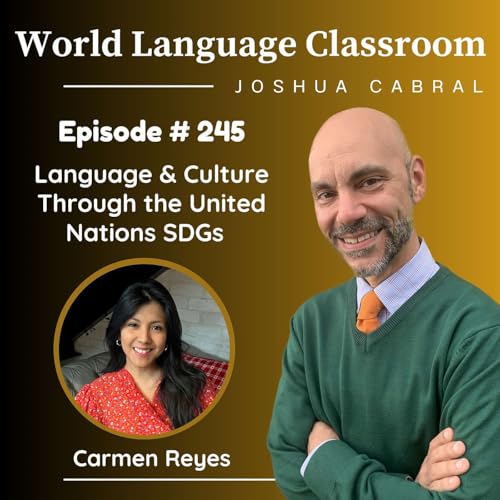
  • Language and Culture Through the United Nations SDGs with Carmen Reyes
    Apr 20 2026

    What if language class could help students talk about the issues shaping our world today? In this episode, I’m joined by Carmen Reyes, a Spanish teacher in Virginia, to explore how the United Nations Sustainable Development Goals can bring language, culture, and global citizenship together in meaningful ways. We talk about what the SDGs are, why they matter, and how they can help students move beyond vocabulary lists to real communication about real issues. Carmen also shares practical, age-appropriate ways to bring these global themes into your classroom without losing the focus on proficiency and communication.

    Topics in this Episode:

    • what the United Nations Sustainable Development Goals are, who created them and why
    • what makes the United Nations Sustainable Development Goals a useful framework for teaching language and culture
    • how the SDGs help students move beyond vocabulary and grammar to see language learning as a way to understand global issues and perspectives
    • how teachers can adapt the SDGs so they are meaningful and accessible for all levels
    • activities or resources that work especially well for integrating the SDGs while keeping the focus on communication in the target language
    • simple and practical ways to start using the using the SDGs
    • Unlocking Fluency: Exploring SDG 16 Through Children’s Literature
    • United Nations Sustainable Development Goals

    Connect with Profe. Carmen Reyes:

    • Instagram - @profe_carmenreyes
    • LinkedIn: Carmen Reyes

    A Few Ways We Can Work Together:

    • Ready For Tomorrow Quick Win PD for Individual Teachers
    • On-Site or Virtual Workshops for Language Departments
    • Self-Paced Program for For Language Departments

    Connect With Me & The World Language Classroom Community:

    • Website: wlclassrom.com
    • Instagram: @wlclassroom
    • Facebook Group: World Language Classroom
    • Facebook: /wlclassroom
    • LinkedIn: Joshua Cabral
    • Bluesky: /wlclassroom.bsky.socia
    • X (Twitter): @wlclassroom
    • Threads: @wlclassroom

    Send me a text and let me know your thoughts on this episode or the podcast.

    Show More Show Less
    35 mins
  • No Prep Speaking and Writing Activities
    Apr 13 2026

    #244

    Have you ever reached the last five minutes of class and thought, I wish my students spoke or wrote a little bit more today… but we didn’t have time. That moment happens to all of us. Not because speaking and writing aren’t important, but because we think those activities require planning, materials, or a carefully designed task. But what if meaningful communication could happen any time in your lesson with almost no preparation? Today I want to share some simple ways to make that happen.

    Topics in this Episode:

    • Sometimes teachers hear “no-prep activity” and imagine something random or filler. But effective quick tasks still have a communicative goal.
    • Students can use language to:
      • describe
      • react
      • suggest
      • explain
      • give an opinion
    • One of the easiest ways to build communication into your lessons is having two or three task structures you can use anytime. Here are three that work across levels.
    • Describe and Guess
    • React and Respond
    • Predict and Confirm
    • Use What You Already Have. One of the biggest misconceptions about speaking tasks is that teachers need special materials. In reality, everyday classroom content can easily become communication prompts.
    • Keep Prompts Open-Ended, Another key feature of effective quick tasks is open-ended prompts. Closed prompts often limit communication.
    • Ready For Tomorrow Quick Win PD Course: No-Prep Speaking and Writing Tasks

    A Few Ways We Can Work Together:

    • Ready For Tomorrow Quick Win PD for Individual Teachers
    • On-Site or Virtual Workshops for Language Departments
    • Self-Paced Program for For Language Departments

    Connect With Me & The World Language Classroom Community:

    • Website: wlclassrom.com
    • Instagram: @wlclassroom
    • Facebook Group: World Language Classroom
    • Facebook: /wlclassroom
    • LinkedIn: Joshua Cabral
    • Bluesky: /wlclassroom.bsky.socia
    • X (Twitter): @wlclassroom
    • Threads: @wlclassroom

    Send me a text and let me know your thoughts on this episode or the podcast.

    Show More Show Less
    20 mins