• Teaching in a Heatwave and is there a Place for Maths Hacks?
    Jul 10 2026

    In this episode of the Primary Maths Podcast, Jon and Becky ask whether we need to change the way we teach maths during a heatwave.

    With classrooms getting hotter and the end of term in sight, they explore what heat can do to attention, working memory, processing speed and classroom engagement. Is it just children being tired and sticky, or is there a genuine cognitive load issue at play?

    They also tackle one of the classic primary maths debates: when multiplying by 10, is it ever OK to say you “put a zero on the end”? Jon and Becky discuss place value, mathematical shortcuts, misconceptions, decimals, fluency, relational understanding and why seeing the structure matters more than simply getting the answer quickly.

    Plus, there’s ice cream ratios, hydration breaks, the Fosbury Flop, Richard Skemp, Jerome Bruner and a reminder that the brand-new PlanIt Maths Place Value resources are now available.

    Explore the new PlanIt Maths Place Value resources here:

    https://www.twinkl.co.uk/l/ndlp8

    Show More Show Less
    30 mins
  • World Cup Maths, Equity and Oracy in the Primary Classroom
    Jul 3 2026

    World Cup Maths, Equity and Oracy in the Primary Classroom

    In this episode of the Primary Maths Podcast, Jon and Becky talk end-of-year school chaos, transition days, classroom moves, and the strange joy of finding a trolley when you really need one.

    The main discussion begins with reflections from the East Midlands West Maths Hub summer conference, where the focus was on equity in maths. Jon shares the powerful question at the heart of the day: who gets to participate in mathematical thinking, and what do we need to do differently in our lesson design so that all pupils can take part?

    Jon and Becky explore the difference between equality and equity, and consider how barriers in maths lessons are not always about individual pupils, but about the structures, routines and expectations around them. They discuss how silent classrooms, prior attainment labels, narrow learning objectives and the rush to find the correct answer can sometimes limit opportunities for mathematical thinking.

    There is also a focus on oracy in maths: why talk matters, how pupils benefit from explaining, reasoning and justifying, and why an incorrect answer can be just as valuable as a correct one when we take time to explore the thinking behind it.

    Later in the episode, attention turns to the World Cup and the many ways teachers can use it as a rich context for maths. Jon shares some World Cup facts and figures, including the first men’s World Cup in Uruguay in 1930, goal totals from past tournaments, stadium capacities, group tables, averages and goal difference.

    Jon and Becky suggest practical classroom ideas across the primary phase, including:

    • counting, sorting, comparing and creating simple pictograms in EYFS and Year 1;
    • using tables, match results and points totals in Years 2 and 3;
    • exploring goal difference, averages, stadium capacities, fairness and predictions in Years 4, 5 and 6;
    • asking open-ended questions such as “What maths can you see?” while watching or looking at images from a match.

    There is plenty here for teachers looking for meaningful end-of-year maths activities, especially when half the class is at transition day, sports day practice, or mysteriously missing because of something involving a clipboard.

    Whether you love football, tolerate football, or only notice it when it interrupts your usual television schedule, this episode is full of ideas for using real-world numbers, live data and sporting excitement to get children talking, thinking and reasoning mathematically.

    Show More Show Less
    33 mins
  • Escape Rooms and Problem Solving (AfterMaths)
    Jun 26 2026

    In this episode of The Primary Maths Podcast, Jon and Becky reflect on the realities of summer term: heatwaves, report writing, and the heroic act of trying to teach when everyone is melting.

    They then turn to problem solving in primary maths, asking whether it should really be saved for the end of the year, or whether pupils need regular, explicit teaching of the skills that help them tackle unfamiliar problems with confidence.

    Jon and Becky discuss six key problem-solving strategies:

    Spotting patterns

    Working systematically

    Using models

    Trialling and improving

    Changing the process

    Making connections

    They also answer a listener question from Priya, a maths lead in Coventry, about what to do when colleagues feel pupils are not fluent enough to access problem solving.

    Finally, in Maths of Life, Jon shares a short history of escape rooms and makes the case that they are a brilliant real-world example of problem solving in action.

    Useful links

    Twinkl Problem Solving Resources: https://www.twinkl.co.uk/r/8arfi

    PlanIt Maths: https://www.twinkl.co.uk/r/wke0f

    Get in touch

    We’d love to hear your thoughts, questions and ideas for future episodes. You can email the show at:

    primarymathspodcast@twinkl.co.uk

    Show More Show Less
    37 mins
  • What We Can Learn from This Year’s Maths SATs?
    Jun 18 2026

    In this aftermaths episode of The Primary Maths Podcast, Jon and Becky take a look back at this year’s KS2 maths SATs papers and ask what teachers and maths leads might learn from them.

    They discuss why the tests should be seen as end-of-key-stage assessments rather than simply Year 6 tests, explore the balance of content across the papers, and reflect on the importance of flexible mathematical thinking. From percentage questions that can be solved in several ways to the role of conceptual understanding in arithmetic, they consider how we can help children move beyond simply following procedures.

    There is also time for Becky’s Maths of Life, where family rounders, mini golf and sporting fairness lead to a chat about the maths hidden in everyday games. Finally, Jon shares a recent meta-analysis on collaborative learning and mathematical creative reasoning, exploring why high-quality tasks, structured discussion and non-routine problem solving can make such a difference.

    A lively episode covering SATs, shape, strategy, sport, collaboration and, naturally, the enduring power of a hash brown.

    Show More Show Less
    34 mins
  • Florence Nightingale: The Lady with the Graph
    Jun 5 2026

    In this lighter half-term Aftermaths episode, Jon and Becky take a wander through some of the unexpected maths hiding in everyday life.

    First up: Samba the escaped capybara, who, at the time of recording, was still causing confusion somewhere near Hampshire. Is it a capybara? Is it a muntjac deer? Has someone accidentally taken in the world’s largest “stray cat”? Hard to say.

    Becky then takes us into the very British world of weather watching, comparing forecasts, choosing the one we like best, and wondering what a “40% chance of rain” actually means. Along the way, there’s discussion of probability, percentages, wind speed, temperature, 24-hour time, tide times, and the slightly chaotic business of trying to predict British weather.

    Jon then shares the story of Florence Nightingale, not just as “the Lady with the Lamp”, but as something else entirely: the Lady with the Graph. Through her use of statistics, record keeping and visual data, Nightingale helped show that far more soldiers were dying from disease and poor hospital conditions than from battle wounds. Her famous polar area diagram became a powerful argument for reform, showing how maths can be used not just to describe the world, but to change it. The Science Museum describes her diagram as showing causes of soldiers’ deaths across two years in Crimea, while the National Army Museum notes the dire conditions at Scutari, where the hospital was dirty, vermin-ridden and lacking basic equipment.

    There’s also a Derbyshire connection, as Jon explains Florence Nightingale’s links to Lea Hurst near Matlock, the Nightingale family’s Derbyshire home.

    In this episode
    • The ongoing mystery of Samba the capybara
    • Why weather apps are full of maths
    • What “chance of rain” really means
    • British weather, rounding, chaos theory and hedging your bets
    • Florence Nightingale’s Derbyshire connections
    • How Nightingale used data visualisation to argue for hospital reform
    • Why graphs can sometimes tell a story more powerfully than tables of numbers

    Show More Show Less
    23 mins
  • Why Problem Solving Needs to be Taught - AfterMaths
    May 22 2026

    In this Aftermaths episode of The Primary Maths Podcast, Jon and Becky chat about the strange, busy, slightly chaotic stretch of the school year just before half term, from transition days and sports events to staffing conversations and year group changes.

    They reflect on how different primary teaching can feel from one year group to another, and why every phase, from EYFS and Key Stage 1 through to Year 6, needs strong subject knowledge and careful teaching.

    The main discussion focuses on working systematically as a key problem solving strategy in primary maths.

    Jon and Becky explore why pupils are often told to “work systematically” without necessarily being taught what that actually means. They discuss how the skill develops from early sorting and ordering in Key Stage 1, through to recording possibilities, finding combinations, identifying factor pairs, proving that all solutions have been found, and eventually supporting algebraic thinking.

    They also consider why working systematically is not just a SATs strategy, but an important part of pupils’ wider mathematical toolkit.

    Topics include:

    • why summer term can feel particularly busy in primary schools
    • the challenge of year group moves and staffing decisions
    • why early maths teaching matters so much
    • how gaps in Key Stage 1 can affect later success in Key Stage 2
    • what working systematically looks like in primary maths
    • why problem solving strategies need to be explicitly taught
    • using sorting, ordering and recording to support systematic thinking
    • factor pairs, common multiples and combinations
    • helping pupils prove they have found all possible solutions
    • the role of manipulatives, representations and talk
    • Twinkl’s new problem solving collection
    • upcoming TeachMeet CPD on working systematically and using models

    Show More Show Less
    34 mins
  • Building Maths Confidence with National Numeracy
    May 19 2026

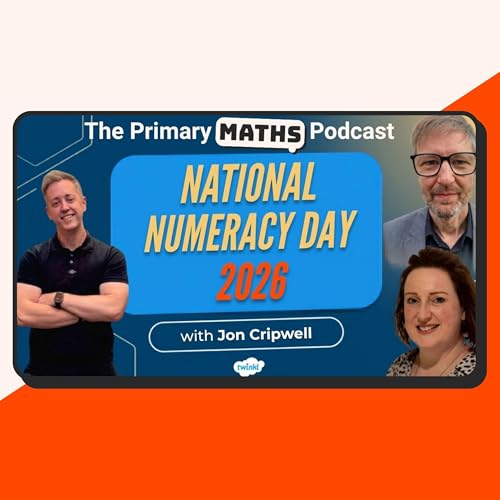
    In this episode of The Primary Maths Podcast, Jon is joined by Paul Milner and Julie Pompa from National Numeracy to talk about number confidence, family engagement and the role schools can play in helping children and adults feel more positive about maths.

    Paul and Julie share the story behind National Numeracy’s work, including why adult numeracy matters and how confidence can be just as important as skill. They discuss the idea that many adults carry negative experiences of maths with them, and how those messages can shape the way children see themselves as mathematicians.

    The conversation explores National Numeracy’s model of value, belief and persistence, and why adults need to see a reason to improve, believe that improvement is possible, and understand that mistakes and discomfort are part of learning.

    Jon, Paul and Julie also discuss the Schools and Families Programme, which supports primary schools to work with families so that pupils feel more positive about maths and understand the value of numeracy beyond the classroom.

    There is also a focus on National Numeracy Day 2026, which takes place on Wednesday 20 May 2026. This year’s theme is Count on Your Community, encouraging schools, workplaces, organisations and community groups to help children and adults feel more confident with numbers at work, at home and at school.

    In this episode, we discuss:

    • why confidence is such an important part of numeracy
    • how adults’ experiences of maths can affect children
    • the difference between maths as a school subject and numeracy in daily life
    • why parents and carers do not need to be “maths people” to support their children
    • the role of mistakes, persistence and positive talk in maths learning
    • how schools can engage families without adding unnecessary workload
    • what National Numeracy Day offers to schools and communities

    Useful links

    National Numeracy

    National Numeracy Day 2026

    National Numeracy Day 2026 schools sign-up

    Schools and Families Programme

    To get in touch with the podcast, email primarymathspodcast@twinkl.co.uk. Becky and Jon will be back on Friday with another Aftermaths episode.

    Show More Show Less
    44 mins
  • Why Doodling Belongs in Maths Lessons - AfterMaths
    May 15 2026

    In this Aftermaths episode of The Primary Maths Podcast, Jon and Becky reflect on a very maths-filled week, from Key Stage 2 SATs to International Women in Mathematics Day, with a little bit of football stadium chat thrown in for good measure.

    Jon and Becky begin by talking about SATs week and the difficult balance teachers face in preparing children well without making the tests feel bigger than they are. They consider the early reactions to this year’s papers, the pressure pupils can feel, and why the final memories of primary maths really matter.

    They also look ahead to the Year 4 Multiplication Tables Check. Jon discusses why fluency with multiplication facts matters, but also why recall alone is not the whole story. Knowing a fact is useful, but pupils also need to understand how to use it.

    Jon then shares reflections from an early maths conference at the King Power Stadium in Leicester, including sessions on maths at home, oracy, bilingual learners and mathematical language. There is plenty to think about here for teachers and maths leads, especially around the role of families in noticing and talking about numbers in the world around them.

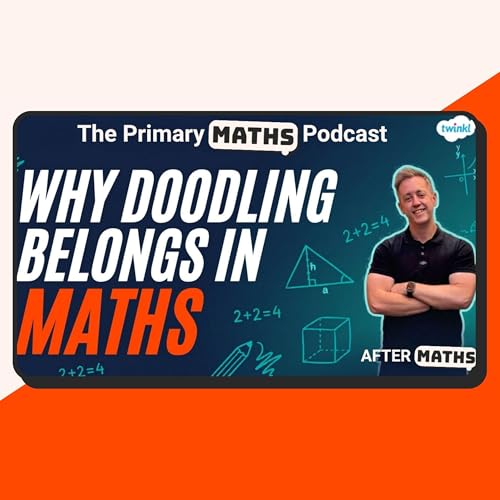
    Becky’s Maths of Life segment marks International Women in Mathematics Day by looking at the work of Maryam Mirzakhani, the first woman to win the Fields Medal. This leads to a lovely discussion about doodling, jotting, visualising and why mathematical thinking does not always need to be neat, polished or trapped inside the squares of a maths book.

    As ever, there are practical reflections for teachers, school leaders and anyone interested in how children come to see themselves as mathematical thinkers.

    Listen, subscribe and get in touch:

    Email: primarymathspodcast@twinkl.co.uk

    Jon on LinkedIn: https://www.linkedin.com/in/joncripwell/

    Primary Maths Podcast Substack: https://primarymathspodcast.substack.com/

    Show More Show Less
    38 mins